


Page 247 - Health, Population and Environment Education 10
P. 247
through respiration. Similarly, various insects, snakes, etc. bite and pierce our body skin
            for poisoning.

            Signs and Symptoms
            Signs and symptoms of poisoning depend on nature of poison, taken amount and medium
            of poisoning. In general, following symptoms are seen in case of poisoning.
            a.  Nausea and vomitting
            b.  Foam in the mouth

            c.  Burning sensation in the mouth, nose, throat, stomach, etc. and abdominal pain
            d.  Restlessness and agitating feeling
            e.  Slow and disordered breathing
            f.   Dryness in skin

            g.  Excessive sweating and salivation
            h.  Variation in the size of eye ball (i.e dilation of eye pupil) and blurred vision
            i.   Confusion and unconscious  with gaining sometimes consciousness.

            First Aid to Poisoning

            a.  The victim is placed in a comfortable position.
            b.  If the poison is swallowed, we should try to remove it by asking the victim to vomit.
                But vomitting is avoided in case of kerosene, petrol, diesel or acid poisoning.

            c.  The eyes are flushed  with clean water in case of eye poisoning.
            d.  Adequate water or milk is provided to the victim if he/she is conscious.
            e.  The victim should be immediately taken to the fresh air area in case of inhaled poison.

            f.   The victim is rushed to the hospital as soon as possible.
            g.  If possible, victim’s vomit and the poison containing vessels should be taken to the
                hospital to identify the nature of poison taken by the victim.

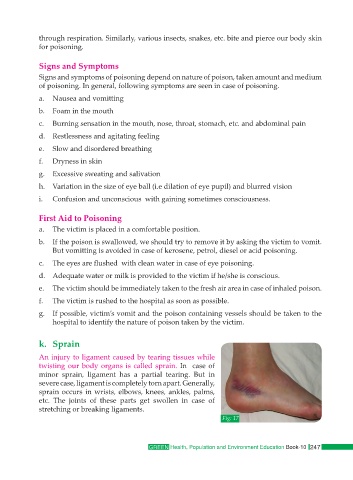
            k.  Sprain

            An injury to ligament caused by tearing tissues while
            twisting our body organs is called sprain. In  case of
            minor sprain, ligament has a partial tearing.  But in
            severe case, ligament is completely torn apart. Generally,
            sprain occurs in wrists, elbows, knees, ankles, palms,
            etc. The joints of these parts get  swollen in case of
            stretching or breaking ligaments.
                                                                  Fig: 17


                                            GREEN  Health, Population and Environment Education Book-10 247

