


Page 75 - Health, Population and Environment Education 10
P. 75
e.  Availability of employment opportunities
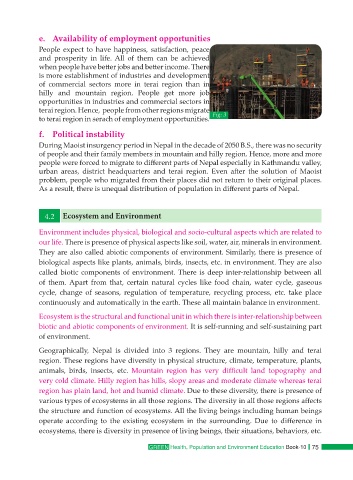
            People expect to have happiness, satisfaction, peace
            and prosperity in life. All of them can be achieved
            when people have better jobs and better income. There
            is more establishment of industries and development
            of commercial  sectors  more  in terai region than in
            hilly and  mountain region. People get more  job
            opportunities in industries and commercial sectors in
            terai region. Hence,  people from other regions migrate   Fig: 3
            to terai region in serach of employment opportunities.
            f.  Political instability
            During Maoist insurgency period in Nepal in the decade of 2050 B.S., there was no security
            of people and their family members in mountain and hilly region. Hence, more and more
            people were forced to migrate to different parts of Nepal especially in Kathmandu valley,
            urban  areas,  district  headquarters  and  terai  region.  Even  after  the  solution  of  Maoist
            problem, people who migrated from their places did not return to their original places.
            As a result, there is unequal distribution of population in different parts of Nepal.


              4.2  Ecosystem and Environment

            Environment includes physical, biological and socio-cultural aspects which are related to
            our life. There is presence of physical aspects like soil, water, air, minerals in environment.
            They are also called abiotic components of environment. Similarly, there is presence of
            biological aspects like plants, animals, birds, insects, etc. in environment. They are also
            called biotic components of environment. There is deep inter-relationship between all
            of them. Apart from that,  certain natural cycles like food chain, water cycle, gaseous
            cycle, change of seasons, regulation  of temperature,  recycling process, etc. take  place
            continuously and automatically in the earth. These all maintain balance in environment.
            Ecosystem is the structural and functional unit in which there is inter-relationship between
            biotic and abiotic components of environment. It is self-running and self-sustaining part
            of environment.

            Geographically, Nepal is divided into 3 regions. They are mountain, hilly  and terai
            region. These regions have diversity in physical structure, climate, temperature, plants,
            animals,  birds, insects,  etc.  Mountain  region  has  very  difficult  land  topography  and
            very cold climate. Hilly region has hills, slopy areas and moderate climate whereas terai
            region has plain land, hot and humid climate. Due to these diversity, there is presence of
            various types of ecosystems in all those regions. The diversity in all those regions affects
            the structure and function of ecosystems. All the living beings including human beings
            operate  according  to  the  existing  ecosystem  in  the  surrounding.  Due  to  difference  in
            ecosystems, there is diversity in presence of living beings, their situations, behaviors, etc.

                                            GREEN  Health, Population and Environment Education Book-10 75

