


Page 89 - Health, Population and Environment Education 10
P. 89
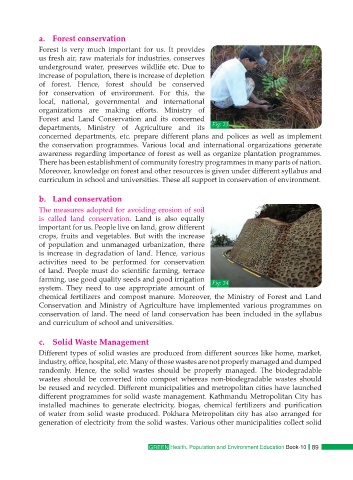
a.  Forest conservation
            Forest is very much  important for us.  It provides
            us fresh air, raw materials for industries, conserves
            underground water, preserves wildlife etc. Due to
            increase of population, there is increase of depletion
            of forest. Hence, forest should  be conserved
            for conservation of environment. For this, the
            local,  national, governmental and international
            organizations  are  making  efforts.  Ministry  of
            Forest and Land Conservation and its concerned
            departments, Ministry of  Agriculture and its      Fig: 23
            concerned departments, etc. prepare different plans and polices as well as implement
            the conservation programmes.  Various  local  and  international organizations generate
            awareness regarding importance of forest as well as organize plantation programmes.
            There has been establishment of community forestry programmes in many parts of nation.
            Moreover, knowledge on forest and other resources is given under different syllabus and
            curriculum in school and universities. These all support in conservation of environment.

            b.  Land conservation
            The measures adopted for avoiding erosion of soil
            is called land conservation.  Land  is  also  equally
            important for us. People live on land, grow different
            crops, fruits and vegetables. But with the increase
            of population and  unmanaged urbanization, there
            is increase in degradation of land. Hence, various
            activities need  to be performed  for  conservation
            of land. People must do scientific farming, terrace
            farming, use good quality seeds and good irrigation   Fig: 24
            system. They need to use appropriate amount of
            chemical  fertilizers and compost manure. Moreover, the Ministry of Forest and Land
            Conservation and Ministry of Agriculture have implemented various programmes on
            conservation of land. The need of land conservation has been included in the syllabus
            and curriculum of school and universities.

            c.  Solid Waste Management
            Different types of solid wastes are produced from different sources like home, market,
            industry, office, hospital, etc. Many of those wastes are not properly managed and dumped
            randomly. Hence, the solid wastes should be properly managed. The biodegradable
            wastes  should  be converted  into compost  whereas  non-biodegradable wastes  should
            be reused and recycled. Different municipalities and metropolitan cities have launched
            different programmes for solid waste management. Kathmandu Metropolitan City has
            installed  machines  to  generate  electricity,  biogas,  chemical  fertilizers  and  purification
            of water from solid waste produced. Pokhara Metropolitan city has also arranged for
            generation of electricity from the solid wastes. Various other municipalities collect solid


                                            GREEN  Health, Population and Environment Education Book-10 89

