


Page 84 - Health, Population and Environment Education 10
P. 84
b.  Livestock Farming
          People in mountain region are involved in animal
          husbandry. With the increase in number of people,
          there is increase in number of cattle as well. There
          is increase in overgrazing  of land by  increased
          number of cattle in mountain region. Hence, the soil
          in mountain region has become weak and there is
          frequent  occurrence  of  soil  erosion  and  landslide.
          People should adopt various ways of animal rearing.  Fig: 13
          They need to cultivate grasses  in their own land
          rather than grazing animals in grassland there.


          c.  Excessive Collection of Medicinal Plants
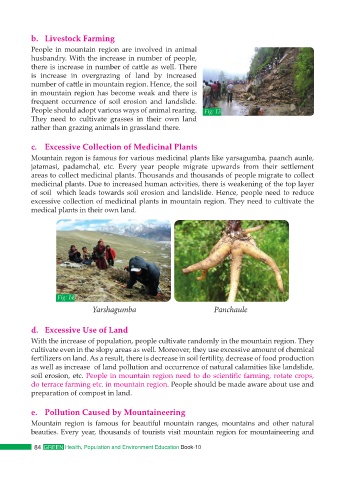
          Mountain regon is famous for various medicinal plants like yarsagumba, paanch aunle,
          jatamasi,  padamchal,  etc.  Every  year  people  migrate  upwards  from  their  settlement
          areas to collect medicinal plants. Thousands and thousands of people migrate to collect
          medicinal plants. Due to increased human activities, there is weakening of the top layer
          of soil  which leads towards soil erosion and landslide. Hence, people need to reduce
          excessive collection of medicinal plants in mountain region. They need to cultivate the
          medical plants in their own land.


                  Fig: 14
                            Yarshagumba                        Panchaule


          d.  Excessive Use of Land
          With the increase of population, people cultivate randomly in the mountain region. They
          cultivate even in the slopy areas as well. Moreover, they use excessive amount of chemical
          fertilizers on land. As a result, there is decrease in soil fertility, decrease of food production
          as well as increase  of land pollution and occurrence of natural calamities like landslide,
          soil erosion, etc. People in mountain region need to do scientific farming, rotate crops,
          do terrace farming etc. in mountain region. People should be made aware about use and
          preparation of compost in land.


          e.  Pollution Caused by Mountaineering
          Mountain region is famous for beautiful mountain ranges, mountains and other natural
          beauties. Every year, thousands of tourists visit mountain region for mountaineering and
           84  GREEN Health, Population and Environment Education Book-10

