


Page 167 - Office Practice and Accounting -9
P. 167
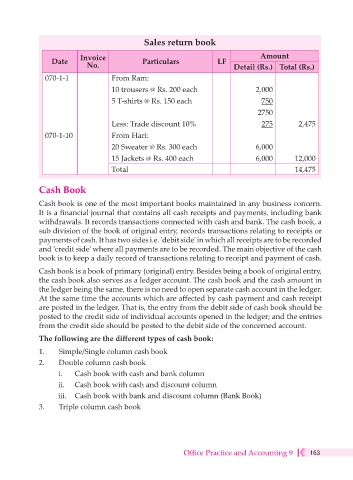
Sales return book

                                                                             Amount
                Date    Invoice           Particulars           LF   Detail (Rs.) Total (Rs.)
                          No.
              070-1-1            From Ram:
                                 10 trousers @ Rs. 200 each                2,000
                                 5 T-shirts @ Rs. 150 each                   750
                                                                            2750

                                 Less: Trade discount 10%                    275        2,475
              070-1-10           From Hari:
                                 20 Sweater @ Rs. 300 each                 6,000
                                 15 Jackets @ Rs. 400 each                 6,000       12,000
                                 Total                                                 14,475

            Cash Book

            Cash book is one of the most important books maintained in any business concern.
            It is a financial journal that contains all cash receipts and payments, including bank
            withdrawals. It records transactions connected with cash and bank. The cash book, a
            sub division of the book of original entry, records transactions relating to receipts or
            payments of cash. It has two sides i.e. 'debit side' in which all receipts are to be recorded
            and 'credit side' where all payments are to be recorded. The main objective of the cash
            book is to keep a daily record of transactions relating to receipt and payment of cash.
            Cash book is a book of primary (original) entry. Besides being a book of original entry,
            the cash book also serves as a ledger account. The cash book and the cash amount in
            the ledger being the same, there is no need to open separate cash account in the ledger.
            At the same time the accounts which are affected by cash payment and cash receipt
            are posted in the ledger. That is, the entry from the debit side of cash book should be
            posted to the credit side of individual accounts opened in the ledger; and the entries
            from the credit side should be posted to the debit side of the concerned account.
            The following are the different types of cash book:

            1.    Simple/Single column cash book
            2.    Double column cash book
                  i.   Cash book with cash and bank column
                  ii.   Cash book with cash and discount column
                  iii.  Cash book with bank and discount column (Bank Book)
            3.    Triple column cash book


                                                      Office Practice and Accounting 9     163

