


Page 10 - Math 4
P. 10
Number System


           1.2 Number, numeral, and digit

                A number is a count of objects or quantities. For example, five fingers,
                five children, five litres of water, and so on.

                 A numeral is a symbol that represents a number. For example, 5 fingers,
                5 children, 5 litres of water, and so on.
                A digit is a single symbol used to make numerals. For example, 2 and 7
                are two digits of the numeral 27.
           1.3 Hindu - Arabic number system


                The Hindu-Arabic number system was first developed by the Hindus.
                Later, this number system was spread by the Arabs all over the world.
                This system has ten basic symbols: they are 0, 1, 2, 3, 4, 5, 6, 7, 8, and 9.
                These symbols are called digits. All the numbers from smaller to larger
                are formed by using these ten digits.

                Devanagari number system is also similar to the Hindu-Arabic number
                system. But it has a bit different digits.

                 Hindu-Arabic digits            0     1   2    3    4     5   6   7     8    9
                 Devanagari digits              )     !   @    #    $     %   ^   &     *    (
                 Devanagari number names        z"Go Ps b'O{ tLg rf/ kfFr 5 ;ft cf7 gf}+

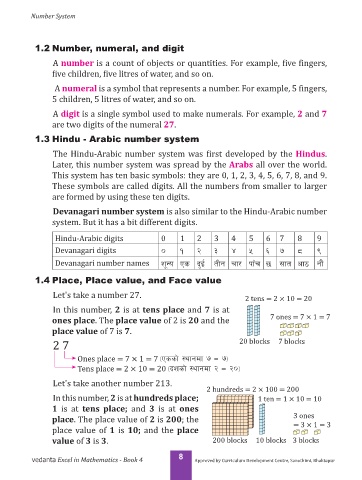
           1.4 Place, Place value, and Face value

                Let's take a number 27.
                                                                        2 tens = 2 × 10 = 20
                In this number, 2 is at tens place and 7 is at
                                                                                7 ones = 7 × 1 = 7
                ones place. The place value of 2 is 20 and the
                place value of 7 is 7.
                                                                       20 blocks  7 blocks
                2 7
                        Ones place = 7 × 1 = 7 -Pssf] :yfgdf & Ö &_
                        Tens place = 2 × 10 = 20 -bzsf] :yfgdf @ Ö @)_

                Let's take another number 213.
                                                             2 hundreds = 2 × 100 = 200
                In this number, 2 is at hundreds place;                     1 ten = 1 × 10 = 10
                1 is  at  tens  place; and  3  is  at  ones
                                                                                      3 ones
                place. The place value of 2 is 200; the
                place value of 1 is 10; and the place                                 = 3 × 1 = 3

                value of 3 is 3.                               200 blocks   10 blocks  3 blocks

          vedanta Excel in Mathematics - Book 4      8    Approved by Curriculum Development Centre, Sanothimi, Bhaktapur

