


Page 186 - leadership-experience-2008
P. 186
CikguOnline
         CikguOnline
               CHAPTER 6: COURAGE AND MORAL LEADERSHIP                                                   167

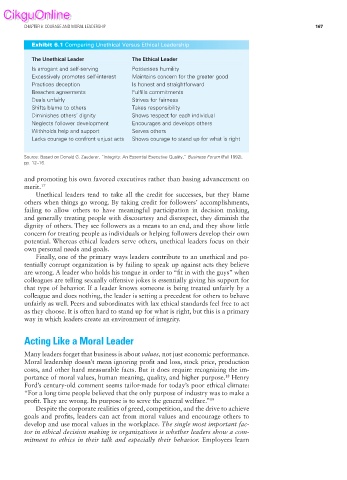
                  Exhibit 6.1 Comparing Unethical Versus Ethical Leadership

                  The Unethical Leader           The Ethical Leader
                  Is arrogant and self-serving   Possesses humility
                  Excessively promotes self-interest   Maintains concern for the greater good
                  Practices deception            Is honest and straightforward
                  Breaches agreements            Fulfills commitments
                  Deals unfairly                 Strives for fairness
                  Shifts blame to others         Takes responsibility
                  Diminishes others’ dignity     Shows respect for each individual
                  Neglects follower development   Encourages and develops others
                  Withholds help and support     Serves others
                  Lacks courage to confront unjust acts   Shows courage to stand up for what is right


               Source: Based on Donald G. Zauderer, “Integrity: An Essential Executive Quality,” Business Forum (Fall 1992),
               pp. 12–16.

               and promoting his own favored executives rather than basing advancement on
               merit. 17
                   Unethical leaders tend to take all the credit for successes, but they blame
                 others when things go wrong. By taking credit for followers’ accomplishments,
               failing to allow others to have meaningful participation in decision making,
               and generally treating people with discourtesy and disrespect, they diminish the
                 dignity of others. They see followers as a means to an end, and they show little
               concern for treating people as individuals or helping followers develop their own
               potential. Whereas ethical leaders serve others, unethical leaders focus on their
               own personal needs and goals.
                   Finally, one of the primary ways leaders contribute to an unethical and po-
               tentially corrupt organization is by failing to speak up against acts they believe
               are wrong. A leader who holds his tongue in order to “fi t in with the guys” when
               colleagues are telling sexually offensive jokes is essentially giving his support for
               that type of behavior. If a leader knows someone is being treated unfairly by a
               colleague and does nothing, the leader is setting a precedent for others to behave
               unfairly as well. Peers and subordinates with lax ethical standards feel free to act
               as they choose. It is often hard to stand up for what is right, but this is a primary
               way in which leaders create an environment of integrity.


               Acting Like a Moral Leader
               Many leaders forget that business is about values, not just economic performance.

               Moral leadership doesn’t mean ignoring profit and loss, stock price,  production
               costs, and other hard measurable facts. But it does require recognizing the im-
               portance of moral values, human meaning, quality, and higher purpose.  Henry
                                                                             18
               Ford’s century-old comment seems tailor-made for today’s poor ethical climate:
               “For a long time people believed that the only purpose of  industry was to make a
               profi t. They are wrong. Its purpose is to serve the general welfare.” 19
                   Despite the corporate realities of greed, competition, and the drive to achieve
               goals and profi ts, leaders can act from moral values and encourage others to
                 develop and use moral values in the workplace. The single most important fac-
               tor in ethical decision making in organizations is whether leaders show a com-
               mitment to ethics in their talk and especially their behavior. Employees learn

