


Page 190 - leadership-experience-2008
P. 190
CikguOnline
         CikguOnline
               CHAPTER 6: COURAGE AND MORAL LEADERSHIP                                                   171

                 IN THE LEAD  civilians, Wallenberg had everything to lose and nothing to gain. Yet he left his
                   life of safety and comfort to enter Hungary under cover as a diplomat, with the
                   mission of saving as many of Hungary’s Jews as possible.  Wallenberg never
                   returned, but apparently was captured as a suspected anti-Soviet spy, and died in
                   a Soviet prison. He gave his life fighting for a cause he believed in, and his actions

                                               27
                   made a real difference in the world.
                   Raoul Wallenberg emerged from a dismal period in human history as a coura-

               geous leader who made the ultimate sacrifice for what he believed Most leaders
               never have the opportunity to save lives, and few leaders help as many people
               as Wallenberg did, but the principles of moral leadership he demonstrated are
               valuable to anyone who aspires to make a positive difference in the world. Moral
               leadership uplifts people, enabling them to be better than they were without the
               leader. Leaders are responsible for building a foundation that strengthens and
               enriches the lives of organization members.

                   Specific personality characteristics such as ego strength, self-confi dence, and
               a sense of independence may enable leaders to behave morally in the face of op-
               position. This chapter’s Leader’s Bookshelf argues that confi dence is a key require-
               ment of moral courage, because it moves leaders from contemplating what is right
               to acting on their moral values. Moreover, leaders can develop these characteris-
               tics through their own hard work. People have choices about whether to behave
               morally. Consider the following remembrance of Viktor Frankl, who was in one
               of the death camps in Nazi Germany.

                   We who lived in concentration camps can remember the men who walked
                   through the huts comforting the others, giving away their last piece of
                   bread. They may have been few in number, but they offer suffi cient proof
                   that everything can be taken from a man but one thing: the last of the
                   human freedoms—to choose one’s attitude in any given set of circum-
                   stances. To choose one’s own way.
                      And there were always choices to make. Every day, every hour, offered
                   the opportunity to make a decision, a decision which determined whether
                   you would or would not submit to those powers which threatened to rob you
                   of your very self, your inner freedom. . . . 28
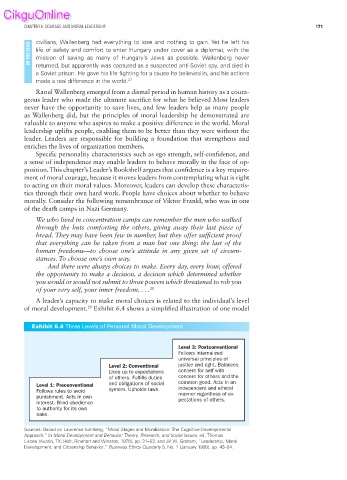
                   A leader’s capacity to make moral choices is related to the individual’s level
               of moral development.  Exhibit 6.4 shows a simplifi ed illustration of one model
                                   29
                  Exhibit 6.4 Three Levels of Personal Moral Development


                                                               Level 3: Postconventional
                                                               Follows internalized
                                                               universal principles of
                                         Level 2: Conventional  justice and right. Balances
                                         Lives up to expectations  concern for self with
                                         of others. Fulfills duties  concern for others and the
                   Level 1: Preconventional  and obligations of social  common good. Acts in an
                   Follows rules to avoid  system. Upholds laws.  independent and ethical
                   punishment. Acts in own                     manner regardless of ex-
                   interest. Blind obedience                   pectations of others.
                   to authority for its own
                   sake.

               Sources: Based on Lawrence Kohlberg, “Moral Stages and Moralization: The Cognitive-Developmental
               Approach,” in Moral Development and Behavior: Theory, Research, and Social Issues, ed. Thomas
               Likona (Austin, TX: Holt, Rinehart and Winston, 1976), pp. 31–53; and Jill W. Graham, “Leadership, Moral
               Development, and Citizenship Behavior,” Business Ethics Quarterly 5, No. 1 (January 1995), pp. 43–54.

