


Page 255 - leadership-experience-2008
P. 255
CikguOnline
      CikguOnline
            236                                                               PART 4: THE LEADER AS A RELATIONSHIP BUILDER

                                     Exhibit 8.6 Key Elements of Expectancy Theory

                                                                            Will putting effort into
                                              E     P  expectancy
                                                                            the task lead to the
                                              Effort            Performance
                                                                            desired performance?


                                                                            Will high performance
                                              P     O  expectancy
                                                                            lead to the desired outcome?
                                              Performance          Outcomes


                                                                            Are the available outcomes
                                             Valence — value of outcomes
                                                                            highly valued?
                                             (pay, recognition, other rewards)


                                                     Motivation


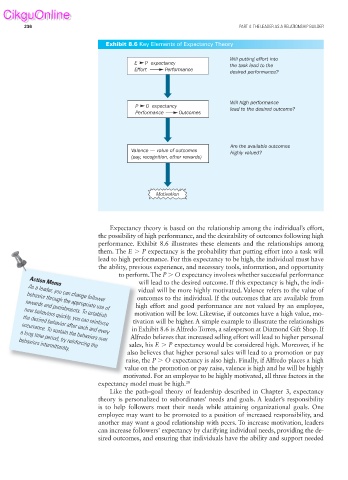
                                       Expectancy theory is based on the relationship among the individual’s effort,
                                   the possibility of high performance, and the desirability of outcomes following high
                                   performance. Exhibit 8.6 illustrates these elements and the relationships among
                                   them. The E   P expectancy is the probability that putting effort into a task will
                                   lead to high performance. For this expectancy to be high, the individual must have
                                   the ability, previous experience, and necessary tools, information, and opportunity
                                         to perform. The P   O expectancy involves whether successful performance
                                               will lead to the desired outcome. If this expectancy is high, the indi-
              Action Memo
                                               vidual will be more highly motivated. Valence refers to the value of
                                               outcomes to the individual. If the outcomes that are available from
             As a leader, you can change follower
                                              high effort and good performance are not valued by an employee,
             behavior through the appropriate use of
                                              motivation will be low. Likewise, if outcomes have a high value, mo-
             rewards and punishments. To establish
                                              tivation will be higher. A simple example to illustrate the relationships
            new behaviors quickly, you can reinforce
                                             in Exhibit 8.6 is Alfredo Torres, a salesperson at Diamond Gift Shop. If
            the desired behavior after each and every
                                             Alfredo believes that increased selling effort will lead to higher personal
           occurrence. To sustain the behaviors over
                                            sales, his E   P expectancy would be considered high. Moreover, if he
           a long time period, try reinforcing the
          behaviors intermittently.
                                            also believes that higher personal sales will lead to a promotion or pay
                                           raise, the P   O expectancy is also high. Finally, if Alfredo places a high
                                           value on the promotion or pay raise, valence is high and he will be highly
                                           motivated. For an employee to be highly motivated, all three factors in the
                                   expectancy model must be high. 28
                                       Like the path–goal theory of leadership described in Chapter 3, expectancy
                                   theory is personalized to subordinates’ needs and goals. A leader’s responsibility
                                   is to help followers meet their needs while attaining organizational goals. One
                                   employee may want to be promoted to a position of increased responsibility, and
                                     another may want a good relationship with peers. To increase motivation, leaders
                                   can  increase followers’ expectancy by clarifying individual needs, providing the de-
                                   sired outcomes, and ensuring that individuals have the ability and support needed

