


Page 250 - leadership-experience-2008
P. 250
CikguOnline
         CikguOnline
               CHAPTER 8: MOTIVATION AND EMPOWERMENT                                                     231

                  Exhibit 8.5 Herzberg’s Two-Factor Theory

                Highly
                Satisfied

                             Area of Satisfaction                     Motivators
                                                    Motivators        influence level
                                                  Achievement         of satisfaction.
                                                  Recognition
                                                  Responsibility
                                                  Work itself
                                                  Personal growth


                Neither
                Satisfied nor
                Dissatisfied
                             Area of Dissatisfaction  Hygiene         Hygiene factors
                                                     Factors          influence level of
                                                                      dissatisfaction.
                                                 Working conditions
                                                 Pay and security
                                                 Company policies
                                                 Supervisors
                                                 Interpersonal
                                                   relationships

                Highly
                Dissatisfied


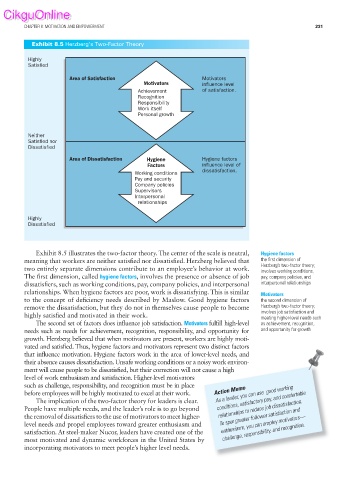
                   Exhibit 8.5 illustrates the two-factor theory. The center of the scale is  neutral,   Hygiene factors
                                                                                        Hygiene factors
                                                                                        the fi rst dimension of

               meaning that workers are neither satisfi ed nor dissatisfied. Herzberg believed that   the fi rst dimension of
                                                                                        Herzberg’s two-factor theory;
                                                                                        Herzberg’s two-factor theory;
               two entirely separate dimensions contribute to an employee’s behavior at work.
                                                                                        involves working conditions,
                                                                                        involves working conditions,
               The fi rst dimension, called hygiene factors, involves the presence or absence of job   pay, company policies, and
                                                                                        pay, company policies, and
                                                                                        interpersonal relationships
               dissatisfiers, such as working conditions, pay, company policies, and interpersonal   interpersonal relationships

               relationships. When hygiene factors are poor, work is dissatisfying. This is similar
                                                                                        Motivators
                                                                                        Motivators
               to the concept of deficiency needs described by Maslow. Good hygiene factors   the second dimension of

                                                                                        the second dimension of
                                                                                        Herzberg’s two-factor theory;
               remove the dissatisfaction, but they do not in themselves cause people to become   Herzberg’s two-factor theory;
                                                                                        involves job satisfaction and
                                                                                        involves job satisfaction and
               highly satisfi ed and motivated in their work.
                                                                                        meeting higher-level needs such
                                                                                        meeting higher-level needs such
                   The second set of factors does influence job satisfaction. Motivators fulfi ll high-level   as achievement, recognition,

                                                                                        as achievement, recognition,
                                                                                        and opportunity for growth
               needs such as needs for achievement, recognition, responsibility, and opportunity for   and opportunity for growth
               growth. Herzberg believed that when motivators are present, workers are highly moti-

               vated and satisfied. Thus, hygiene factors and motivators represent two distinct factors
               that influence motivation. Hygiene factors work in the area of lower-level needs, and

               their absence causes dissatisfaction. Unsafe working conditions or a noisy work environ-
               ment will cause people to be  dissatisfied, but their correction will not cause a high

               level of work enthusiasm and satisfaction. Higher-level motivators
               such as challenge, responsibility, and recognition must be in place
                                                                          As a leader, you can use  good working
               before employees will be highly motivated to excel at their work.  Action Memo
                   The implication of the two-factor theory for leaders is clear.   conditions, satisfactory pay, and comfortable
               People have multiple needs, and the leader’s role is to go beyond   relationships to reduce job dissatisfaction.

               the removal of dissatisfiers to the use of motivators to meet higher-  To spur greater follower satisfaction and
               level needs and propel employees toward greater enthusiasm and   enthusiasm, you can employ motivators—
               satisfaction. At steel-maker Nucor, leaders have created one of the   challenge, responsibility, and recognition.
               most motivated and dynamic workforces in the United States by
               incorporating motivators to meet people’s higher level needs.

