


Page 314 - leadership-experience-2008
P. 314
CikguOnline
         CikguOnline
               CHAPTER 10: LEADING TEAMS                                                                 295

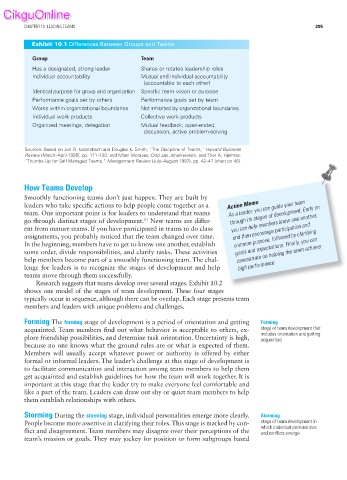
                  Exhibit 10.1 Differences Between Groups and Teams

                  Group                            Team
                  Has a designated, strong leader   Shares or rotates leadership roles
                  Individual accountability        Mutual and individual accountability
                                                     (accountable to each other)
                  Identical purpose for group and organization  Specific team vision or purpose
                  Performance goals set by others   Performance goals set by team
                  Works within organizational boundaries   Not inhibited by organizational boundaries
                  Individual work products         Collective work products
                  Organized meetings, delegation   Mutual feedback, open-ended
                                                     discussion, active problem-solving

               Sources: Based on Jon R. Katzenbach and Douglas K. Smith, “The Discipline of Teams,” Harvard Business
               Review (March–April 1995), pp. 111–120; and Milan Moravec, Odd Jan Johannessen, and Thor A. Hjelmas,
               “Thumbs Up for Self-Managed Teams,” Management Review (July–August 1997), pp. 42–47 (chart on 46).


               How Teams Develop
               Smoothly functioning teams don’t just happen. They are built by
                                                                              As a leader, you can guide your team
               leaders who take specific actions to help people come together as a   Action Memo

               team. One important point is for leaders to understand that teams   through its stages of development. Early on
                                                    11
               go through distinct stages of development.  New teams are differ-  you can help members know one another,
               ent from mature teams. If you have participated in teams to do class   and then encourage participation and
               assignments, you probably noticed that the team changed over time.   common purpose, followed by clarifying
               In the beginning, members have to get to know one another, establish   goals and expectations. Finally, you can
               some order, divide responsibilities, and clarify tasks. These activities   concentrate on helping the team achieve
               help members become part of a smoothly functioning team. The chal-
               lenge for leaders is to recognize the stages of development and help   high performance.
               teams move through them successfully.
                   Research suggests that teams develop over several stages.  Exhibit 10.2
               shows one model of the stages of team development. These four stages
                 typically occur in sequence, although there can be overlap. Each stage  presents team
               members and leaders with unique problems and challenges.

               Forming The forming stage of development is a period of orientation and getting   Forming
                                                                                        Forming
                                                                                        stage of team development that
               acquainted. Team members find out what behavior is acceptable to others, ex-  stage of team development that

                                                                                        includes orientation and getting
                                                                                        includes orientation and getting
               plore friendship possibilities, and determine task orientation. Uncertainty is high,   acquainted
                                                                                        acquainted
               because no one knows what the ground rules are or what is expected of them.
               Members will usually accept whatever power or authority is offered by either
               formal or informal leaders. The leader’s challenge at this stage of development is
               to facilitate communication and interaction among team members to help them
               get acquainted and establish guidelines for how the team will work together. It is
               important at this stage that the leader try to make everyone feel comfortable and
               like a part of the team. Leaders can draw out shy or quiet team members to help
               them establish relationships with others.
               Storming During the storming stage, individual personalities emerge more clearly.   Storming
                                                                                        Storming
                                                                                        stage of team development in
               People become more assertive in clarifying their roles. This stage is marked by con-  stage of team development in
                                                                                        which individual personalities
                                                                                        which individual personalities
               fl ict and disagreement. Team members may disagree over their perceptions of the   and confl icts emerge
                                                                                        and confl icts emerge
               team’s mission or goals. They may jockey for position or form subgroups based

