


Page 315 - leadership-experience-2008
P. 315
CikguOnline
      CikguOnline
            296                                                               PART 4: THE LEADER AS A RELATIONSHIP BUILDER

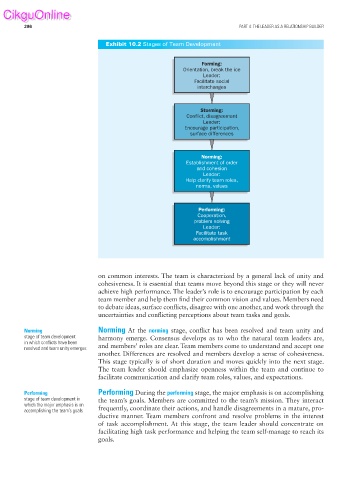
                                     Exhibit 10.2 Stages of Team Development


                                                                   Forming:
                                                             Orientation, break the ice
                                                                   Leader:
                                                                 Facilitate social
                                                                  interchanges


                                                                   Storming:
                                                              Conflict, disagreement
                                                                   Leader:
                                                              Encourage participation,
                                                               surface differences


                                                                   Norming:
                                                              Establishment of order
                                                                 and cohesion
                                                                   Leader:
                                                              Help clarify team roles,
                                                                 norms, values


                                                                  Performing:
                                                                  Cooperation,
                                                                 problem solving
                                                                   Leader:
                                                                 Facilitate task
                                                                accomplishment


                                   on common interests. The team is characterized by a general lack of unity and
                                   cohesiveness. It is essential that teams move beyond this stage or they will never
                                   achieve high performance. The leader’s role is to encourage participation by each

                                   team member and help them find their common vision and values. Members need
                                   to debate ideas, surface conflicts, disagree with one another, and work through the

                                   uncertainties and confl icting perceptions about team tasks and goals.

            Norming                Norming At the  norming stage, conflict has been resolved and team unity and
            Norming
            stage of team development
            stage of team development   harmony emerge. Consensus develops as to who the natural team leaders are,
            in which confl icts have been
            in which confl icts have been
            resolved and team unity emerges
            resolved and team unity emerges  and members’ roles are clear. Team members come to understand and accept one
                                   another. Differences are resolved and members develop a sense of cohesiveness.
                                   This stage typically is of short duration and moves quickly into the next stage.
                                   The team leader should emphasize openness within the team and continue to
                                     facilitate communication and clarify team roles, values, and expectations.
            Performing
            Performing             Performing During the performing stage, the major emphasis is on accomplishing
            stage of team development in
            stage of team development in   the team’s goals. Members are committed to the team’s mission. They interact
            which the major emphasis is on
            which the major emphasis is on
            accomplishing the team’s goals
            accomplishing the team’s goals  frequently, coordinate their actions, and handle disagreements in a mature, pro-
                                   ductive manner. Team members confront and resolve problems in the interest
                                   of task accomplishment. At this stage, the team leader should concentrate on
                                   facilitating high task performance and helping the team self-manage to reach its
                                   goals.

