


Page 328 - leadership-experience-2008
P. 328
CikguOnline
         CikguOnline
               CHAPTER 10: LEADING TEAMS                                                                 309
               the contributions of lower-level support staff. One woman who has held the same
               secretarial position for many years attributes her high enthusiasm to her team
               leader: “For the last several years, our team of four has reported to him. At the
               end of each day—no matter how hectic or trying things have been—he comes by
               each of our desks and says, ‘Thank you for another good day.’” 54


               The Leader’s New Challenge: Virtual and Global Teams

               Being a team leader is even more challenging when people are scattered in dif-
               ferent geographical locations and may be separated by language and cultural
               differences as well. Virtual and global teams are a reality for many of today’s
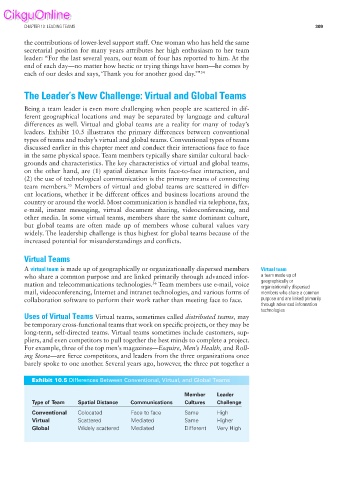
               leaders. Exhibit 10.5 illustrates the primary differences between conventional
               types of teams and today’s virtual and global teams. Conventional types of teams
               discussed earlier in this chapter meet and conduct their interactions face to face
               in the same physical space. Team members typically share similar cultural back-
               grounds and characteristics. The key characteristics of virtual and global teams,
               on the other hand, are (1) spatial distance limits face-to-face interaction, and
               (2) the use of technological communication is the primary means of connecting
                             55
               team members.  Members of virtual and global teams are scattered in differ-
               ent locations, whether it be different offi ces and business locations around the
               country or around the world. Most communication is handled via telephone, fax,
               e-mail, instant messaging, virtual document sharing, videoconferencing, and
               other media. In some virtual teams, members share the same dominant culture,
               but global teams are often made up of members whose cultural values vary
               widely. The leadership challenge is thus highest for global teams because of the
               increased potential for misunderstandings and confl icts.

               Virtual Teams
               A virtual team is made up of geographically or organizationally dispersed members   Virtual team
                                                                                        Virtual team
                                                                                        a team made up of
               who share a common purpose and are linked primarily through advanced infor-  a team made up of
                                                                                        geographically or
                                                       56
               mation and telecommunications technologies.  Team members use e-mail, voice   geographically or
                                                                                        organizationally dispersed
                                                                                        organizationally dispersed
               mail, videoconferencing, Internet and intranet technologies, and various forms of   members who share a common
                                                                                        members who share a common
                                                                                        purpose and are linked primarily
               collaboration software to perform their work rather than meeting face to face.  purpose and are linked primarily
                                                                                        through advanced information
                                                                                        through advanced information
                                                                                        technologies
                                                                                        technologies
               Uses of Virtual Teams Virtual teams, sometimes called distributed teams, may
               be temporary cross-functional teams that work on specific projects, or they may be

               long-term, self-directed teams. Virtual teams sometimes include customers, sup-
               pliers, and even competitors to pull together the best minds to complete a project.
               For example, three of the top men’s magazines—Esquire, Men’s Health, and Roll-
               ing Stone—are fierce competitors, and leaders from the three organizations once

               barely spoke to one another. Several years ago, however, the three put together a
                  Exhibit 10.5 Differences Between Conventional, Virtual, and Global Teams
                                                                 Member    Leader
                  Type of  Team   Spatial Distance   Communications   Cultures   Challenge
                  Conventional   Colocated      Face to face     Same      High
                  Virtual       Scattered       Mediated         Same      Higher
                  Global        Widely scattered   Mediated      Different   Very High

