


Page 333 - leadership-experience-2008
P. 333
CikguOnline
      CikguOnline
            314                                                               PART 4: THE LEADER AS A RELATIONSHIP BUILDER
                                   Causes of Conflict
                                   Leaders can be aware of several factors that cause confl ict among individuals or
                                   teams. Whenever teams compete for scarce resources, such as money, informa-
                                               tion, or supplies, confl ict is almost inevitable. Confl icts also emerge
             Action Memo
                                               when task responsibilities are unclear. People might disagree about
                                              who has responsibility for specifi c tasks or who has a claim on
                                              resources, and leaders help members reach agreement. Another rea-
             As a leader, you can adopt the best approach
                                             son for confl ict is simply because individuals or teams are pursuing
            for handling a team confl  ict. Choose among
            the competing, avoiding, compromising,
                                             confl icting goals. For example, individual salespeople’s targets may
           accommodating, or collaborating styles
                                             put them in confl ict with one another and with the sales manager.
           based on the degree of assertiveness and
                                            Finally, it sometimes happens that two people simply do not get along
          situation.
           cooperativeness needed to manage the
                                            with one another and will never see eye to eye on any issue. Personality
                                           clashes are caused by basic differences in personality, values, and atti-
                                           tudes, as described in Chapter 4, and can be particularly diffi cult to deal
                                           with. Sometimes, the only solution is to separate the parties and reassign
                                          them to other teams where they can be more productive.
                                   Styles to Handle Conflict
                                   Teams as well as individuals develop specific styles for dealing with confl ict, based

                                   on the desire to satisfy their own concerns versus the other party’s concerns.
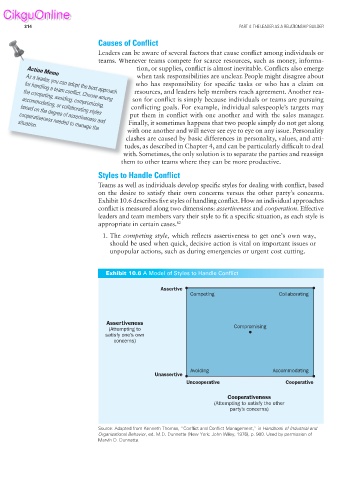
                                     Exhibit 10.6 describes five styles of handling conflict. How an individual approaches


                                   conflict is measured along two dimensions: assertiveness and cooperation. Effective


                                   leaders and team members vary their style to fit a specific situation, as each style is

                                   appropriate in certain cases. 82
                                    1. The competing style, which reflects assertiveness to get one’s own way,
                                       should be used when quick, decisive action is vital on important issues or
                                       unpopular actions, such as during emergencies or urgent cost cutting.

                                     Exhibit 10.6 A Model of Styles to Handle Conflict

                                                      Assertive
                                                               Competing                   Collaborating


                                     Assertiveness
                                      (Attempting to                         Compromising
                                     satisfy one’s own
                                        concerns)


                                                               Avoiding                  Accommodating
                                                    Unassertive
                                                              Uncooperative                  Cooperative

                                                                           Cooperativeness
                                                                       (Attempting to satisfy the other
                                                                            party’s concerns)


                                   Source: Adapted from Kenneth Thomas, “Conflict and Conflict Management,” in Handbook of Industrial and
                                   Organizational Behavior, ed. M.D. Dunnette (New York: John Wiley, 1976), p. 900. Used by permission of
                                   Marvin D. Dunnette.

