


Page 397 - leadership-experience-2008
P. 397
CikguOnline
      CikguOnline
            378                                                               PART 4: THE LEADER AS A RELATIONSHIP BUILDER

               Exhibit 12.7 Guidelines for Ethical Action


                     Is the action
                                        Does the action
                     consistent with the                 Does the action    Would you wish
                                        respect the rights of
                     organization's goals,               meet the standards   others to behave in  Ethical
                                        individuals and
                     rather than being                   of fairness and    the same way if the  Choice
                                        groups affected
                     motivated purely by                 equity?            action affected you?
                                        by it?
                     self-interest?
            Sources: Based on G. F. Cavanaugh, D. J. Mobert, and M. Valasques, “The Ethics of Organizational Politics, “Academy of Management Journal,
            (June 1981), pp. 363–374; and Stephen P. Robbins, Organizational Behavior, 8th ed. (Upper Saddle River, NJ: Prentice Hall, 1998), p. 422.
                                   whether or not the leader actually withholds the resources. Partly in response to
                                   pressures from the courts, many organizations are developing policies and pro-
                                   cedures that protect individuals from sexual harassment on the job and offer
                                   mechanisms for reporting complaints. Sexual harassment is not just unethical, it
                                   is illegal, and it is a clear abuse of power.
                                       However, there are many other situations in organizations that are not so
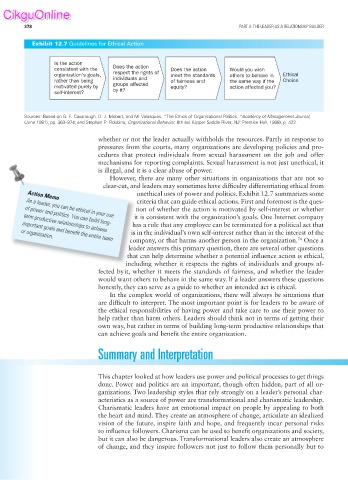
                                    clear-cut, and leaders may sometimes have difficulty differentiating ethical from

                                               unethical uses of power and politics. Exhibit 12.7 summarizes some
             Action Memo
                                               criteria that can guide ethical actions. First and foremost is the ques-
                                              tion of whether the action is motivated by self-interest or whether
             As a leader, you can be ethical in your use
                                              it is consistent with the organization’s goals. One Internet company
            of power and politics. You can build long-
                                             has a rule that any employee can be terminated for a political act that
            term productive relationships to achieve
                                             is in the individual’s own self-interest rather than in the interest of the
           or organization.
           important goals and benefi  t the entire team
                                             company, or that harms another person in the organization.  Once a
                                                                                                74
                                            leader answers this primary question, there are several other questions

                                            that can help determine whether a potential influence action is ethical,
                                           including whether it respects the rights of individuals and groups af-
                                   fected by it, whether it meets the standards of fairness, and whether the leader
                                   would want others to behave in the same way. If a leader answers these questions
                                   honestly, they can serve as a guide to whether an intended act is ethical.
                                       In the complex world of organizations, there will always be situations that

                                   are difficult to interpret. The most important point is for leaders to be aware of
                                   the ethical responsibilities of having power and take care to use their power to
                                   help rather than harm others. Leaders should think not in terms of getting their
                                   own way, but rather in terms of building long-term productive relationships that
                                   can achieve goals and benefi t the entire organization.

                                   Summary and Interpretation


                                   This chapter looked at how leaders use power and political processes to get things
                                   done. Power and politics are an important, though often hidden, part of all or-
                                   ganizations. Two leadership styles that rely strongly on a leader’s personal char-
                                   acteristics as a source of power are transformational and charismatic leadership.
                                   Charismatic leaders have an emotional impact on people by appealing to both
                                   the heart and mind. They create an atmosphere of change, articulate an idealized
                                   vision of the future, inspire faith and hope, and frequently incur personal risks


                                   to influence followers. Charisma can be used to benefit organizations and society,
                                   but it can also be dangerous. Transformational leaders also create an atmosphere
                                   of change, and they inspire followers not just to follow them personally but to

