


Page 393 - leadership-experience-2008
P. 393
CikguOnline
      CikguOnline
            374                                                               PART 4: THE LEADER AS A RELATIONSHIP BUILDER
                                   Tactics for Asserting Leader Influence

                                   The next issue is how leaders use their power to implement decisions, facilitate
                                   change, and pursue organizational goals. That is, leaders use power to infl uence

                                   others, which requires both skill and willingness. Much influence is interpersonal
                                              and one-on-one. This is social influence, which involves coalitions, re-

             Action Memo

                                               wards, and inspiration. Other influence has broader appeal, such as

                                               to influence the organization as a whole, or to influence those outside

                                              the organization. However, not all attempts to use power result in
             As a leader, you can use political activity

                                              actual influence. Some power moves are rejected by followers, particu-
            to achieve important organizational goals
                                             larly if they are seen to be self-serving. Leaders have to determine the
            when there is uncertainty or disagreement
                                             best approach for using their power—that is, the approach that is most
           about choices. You can develop connections

                                             likely to influence others—by considering the individuals, groups, and
           with powerful people by volunteering for
                                                             55
                                            situations involved.  In addition, they understand the basic principles
           diffi  cult projects and serving on committees.
                                            that can cause people to change their behavior or attitudes.

                                               Leaders frequently use a combination of influence strategies, and
                                           people who use a wider variety of tactics are typically perceived as having
                                   greater power and influence. One survey of a few hundred leaders identifi ed more

                                   than 4,000 different techniques by which these people were able to infl uence others
                                   to do what the leader wanted.  However, the myriad successful infl uence tactics
                                                             56
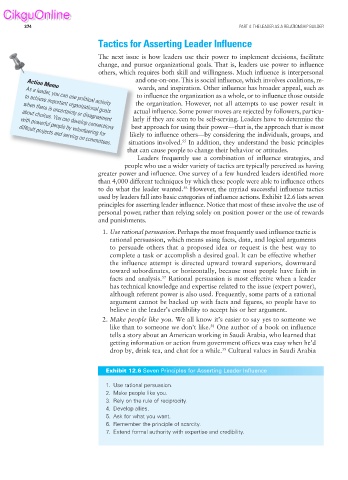
                                   used by leaders fall into basic categories of influence actions. Exhibit 12.6 lists seven

                                   principles for asserting leader influence. Notice that most of these involve the use of

                                   personal power, rather than relying solely on position power or the use of rewards
                                   and punishments.
                                    1. Use rational persuasion. Perhaps the most frequently used influence tactic is
                                       rational persuasion, which means using facts, data, and logical arguments
                                       to persuade others that a proposed idea or request is the best way to
                                       complete a task or accomplish a desired goal. It can be effective whether
                                       the influence attempt is directed upward toward superiors, downward
                                       toward subordinates, or horizontally, because most people have faith in
                                                       57
                                       facts and analysis.  Rational persuasion is most effective when a leader
                                       has technical knowledge and expertise related to the issue (expert power),
                                       although referent power is also used. Frequently, some parts of a rational
                                       argument cannot be backed up with facts and figures, so people have to
                                       believe in the leader’s credibility to accept his or her argument.
                                    2. Make people like you. We all know it’s easier to say yes to someone we
                                                                      58
                                       like than to someone we don’t like.  One author of a book on influence
                                       tells a story about an American working in Saudi Arabia, who learned that
                                       getting information or action from government offices was easy when he’d
                                                                         59
                                       drop by, drink tea, and chat for a while.  Cultural values in Saudi Arabia
                                     Exhibit 12.6 Seven Principles for Asserting Leader Influence
                                     1.  Use rational persuasion.
                                     2.  Make people like you.
                                     3.  Rely on the rule of reciprocity.
                                     4. Develop allies.
                                     5.  Ask for what you want.
                                     6.  Remember the principle of scarcity.
                                     7.  Extend formal authority with expertise and credibility.

