


Page 429 - leadership-experience-2008
P. 429
CikguOnline
      CikguOnline
            410                                                                   PART 5: THE LEADER AS SOCIAL ARCHITECT

                                     Exhibit 13.8 Linking Strategic Vision and Strategic Action

                                            High
                                                          The Dreamer             The Effective Leader
                                     Vision
                                                         The Uninvolved               The Doer
                                            Low
                                                Low                                                High
                                                                         Action

                                   Source: Based on William D. Hitt, The Leader–Manager: Guidelines for Action (Columbus, OH: Battelle Press,
                                   1988), p. 7.


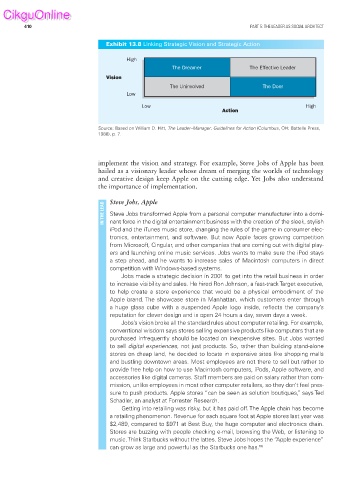
                                   implement the vision and strategy. For example, Steve Jobs of Apple has been
                                   hailed as a visionary leader whose dream of merging the worlds of technology
                                   and creative design keep Apple on the cutting edge. Yet Jobs also understand
                                   the importance of implementation.


                                     IN THE LEAD  Steve Jobs, Apple
                                       Steve Jobs transformed Apple from a personal computer manufacturer into a domi-
                                       nant force in the digital entertainment business with the creation of the sleek, stylish
                                       iPod and the iTunes music store, changing the rules of the game in consumer elec-
                                       tronics, entertainment, and software. But now Apple faces growing competition
                                       from Microsoft, Cingular, and other companies that are coming out with digital play-
                                       ers and launching online music services. Jobs wants to make sure the iPod stays
                                       a step ahead, and he wants to increase sales of Macintosh computers in direct
                                       competition with Windows-based systems.
                                          Jobs made a strategic decision in 2001 to get into the retail business in order
                                       to increase visibility and sales. He hired Ron Johnson, a fast-track Target executive,
                                       to help create a store experience that would be a physical embodiment of the
                                       Apple brand. The showcase store in Manhattan, which customers enter through

                                       a huge glass cube with a suspended Apple logo inside, reflects the company’s
                                       reputation for clever design and is open 24 hours a day, seven days a week.
                                          Jobs’s vision broke all the standard rules about computer retailing. For example,
                                       conventional wisdom says stores selling expensive products like computers that are
                                       purchased infrequently should be located on inexpensive sites. But Jobs wanted
                                       to sell digital experiences, not just products. So, rather than building stand-alone
                                       stores on cheap land, he decided to locate in expensive sites like shopping malls
                                       and bustling downtown areas. Most employees are not there to sell but rather to
                                       provide free help on how to use Macintosh computers, iPods, Apple software, and
                                       accessories like digital cameras. Staff members are paid on salary rather than com-
                                       mission, unlike employees in most other computer retailers, so they don’t feel pres-
                                       sure to push products. Apple stores “can be seen as solution boutiques,” says Ted
                                       Schadler, an analyst at Forrester Research.
                                          Getting into retailing was risky, but it has paid off. The Apple chain has become
                                       a retailing phenomenon. Revenue for each square foot at Apple stores last year was
                                       $2,489, compared to $971 at Best Buy, the huge computer and electronics chain.
                                       Stores are buzzing with people checking e-mail, browsing the Web, or listening to
                                       music. Think Starbucks without the lattes. Steve Jobs hopes the “Apple experience”
                                       can grow as large and powerful as the Starbucks one has. 66

