


Page 425 - leadership-experience-2008
P. 425
CikguOnline
      CikguOnline
            406                                                                   PART 5: THE LEADER AS SOCIAL ARCHITECT
                                   as much as 70 percent of all business strategies never get implemented, refl ecting
                                   the complexity of strategy implementation. 58
                                       Strategy implementation involves using several tools or parts of the organiza-
                                   tion that can be adjusted to put strategy into action. Strong leadership is one of
                                   the most important tools for strategy implementation. Follower support for the
                                   strategic plan is essential for successful implementation, and leaders create the en-
                                   vironment that determines whether people understand and feel committed to the
                                   company’s strategic direction. People who feel trust in their leaders and commit-
                                   ment to the organization are typically more supportive of strategy and put forth
                                   more effort to implement strategic decisions. 59
                                       As an example of using leadership in strategy implementation, the manager
                                   of a department store might implement a strategy of better customer service by
                                   pumping up morale, encouraging greater interaction with customers, being phys-
                                   ically present on the sales fl oor, and speaking enthusiastically with  employees
                                   about providing quality service. Strategy is also implemented through organiza-
                                   tional elements such as structural design, pay or reward systems, budget alloca-
                                   tions, and organizational rules, policies, or procedures. Leaders are responsible
                                   for making decisions about changes in structure, systems, policies, and so forth,
                                   to support the company’s strategic direction. When she was  general manager
                                   of the  Applebee’s Neighborhood Grill & Bar in Mankato, Minnesota, Lisa
                                     Hofferbert implemented a strategy of increased sales by budgeting for news-
                                   paper and radio ads asking customers to help the store break a sales record,
                                   designing daily incentive-based contests for employees, redesigning employee
                                   parking policies to give greater access for customers to park near the store, and
                                   making the sales target a mandatory topic on the agenda for every staff meeting.
                                   These changes, combined with Hofferbert’s inspirational leadership and com-
                                   mitment to taking care of her employees, helped the store meet her ambitious
                                   goal of $3 million in sales for the year. 60
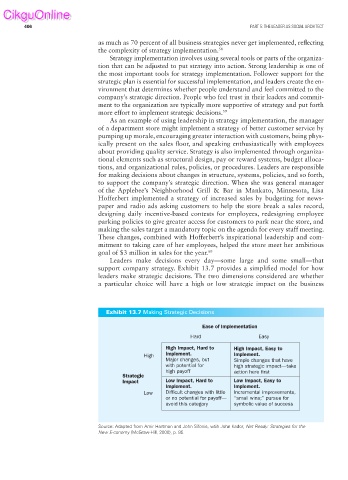
                                       Leaders make decisions every day—some large and some small—that
                                   support company strategy. Exhibit 13.7 provides a simplifi ed model for how
                                   leaders make strategic decisions. The two dimensions considered are whether
                                   a particular choice will have a high or low strategic impact on the business


                                     Exhibit 13.7 Making Strategic Decisions
                                                                   Ease of Implementation
                                                               Hard                 Easy

                                                        High Impact, Hard to  High Impact, Easy to
                                                 High   Implement.           Implement.
                                                        Major changes, but   Simple changes that have
                                                        with potential for   high strategic impact—take
                                                        high payoff          action here first
                                          Strategic
                                          Impact        Low Impact, Hard to   Low Impact, Easy to
                                                        Implement.           Implement.
                                                 Low    Difficult changes with little  Incremental improvements,
                                                        or no potential for payoff—  “small wins;” pursue for
                                                        avoid this category  symbolic value of success


                                   Source: Adapted from Amir Hartman and John Sifonis, wtih John Kador, Net Ready: Strategies for the
                                   New E-conomy (McGraw-Hill, 2000), p. 95.

