


Page 91 - leadership-experience-2008
P. 91
CikguOnline
      CikguOnline
            72                                                                PART 2: RESEARCH PERSPECTIVES ON LEADERSHIP
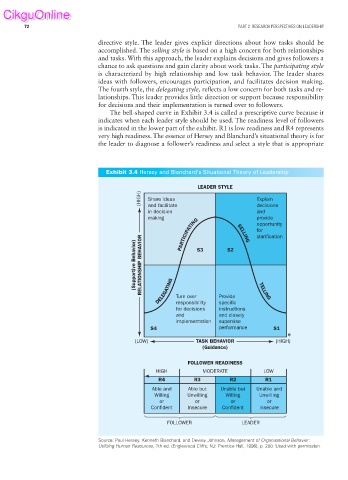
                                   directive style. The leader gives explicit directions about how tasks should be
                                     accomplished. The selling style is based on a high concern for both relationships
                                   and tasks. With this approach, the leader explains decisions and gives followers a
                                   chance to ask questions and gain clarity about work tasks. The participating style
                                   is characterized by high relationship and low task behavior. The leader shares
                                   ideas with followers, encourages participation, and facilitates decision making.

                                   The fourth style, the delegating style, reflects a low concern for both tasks and re-
                                   lationships. This leader provides little direction or support because responsibility
                                   for decisions and their implementation is turned over to followers.
                                       The bell-shaped curve in Exhibit 3.4 is called a prescriptive curve because it
                                   indicates when each leader style should be used. The readiness level of followers
                                   is indicated in the lower part of the exhibit. R1 is low readiness and R4 represents
                                   very high readiness. The essence of Hersey and Blanchard’s situational theory is for
                                   the leader to diagnose a follower’s readiness and select a style that is appropriate


                                     Exhibit 3.4 Hersey and Blanchard’s Situational Theory of Leadership
                                                                  LEADER STYLE
                                                (HIGH)  Share ideas                 Explain
                                                  and facilitate
                                                                                    decisions
                                                  in decision                       and
                                                  making    PARTICIPATING     SELLING  provide
                                                                                    opportunity
                                                                                    for
                                                                                    clarification
                                              (Supportive Behavior) RELATIONSHIP BEHAVIOR  S3  S2


                                                     DELEGATING


                                                           Turn over
                                                           responsibility
                                                                        specific
                                                                        instructions
                                                           for decisions  Provide    TELLING
                                                           and          and closely
                                                           implementation  supervise
                                                   S4                   performance      S1
                                                                                             ®
                                              (LOW)              TASK BEHAVIOR            (HIGH)
                                                                   (Guidance)
                                                               FOLLOWER READINESS
                                                     HIGH          MODERATE           LOW
                                                      R4         R3         R2        R1
                                                    Able and   Able but  Unable but  Unable and
                                                    Willing   Unwilling   Willing    Unwilling
                                                      or         or         or         or
                                                   Confident   Insecure  Confident   Insecure

                                                        FOLLOWER               LEADER

                                   Source: Paul Hersey, Kenneth Blanchard, and Dewey Johnson, Management of Organizational Behavior:
                                   Utilizing Human Resources, 7th ed. (Englewood Cliffs, NJ: Prentice Hall, 1996), p. 200. Used with permission.

