


Page 232 - Nursing: The Philosophy and Science of Caring
P. 232
I nt EG ral M odEl f o r  G ra s P I nG  nE E d s   In  C ar it a s  n u r s i n g
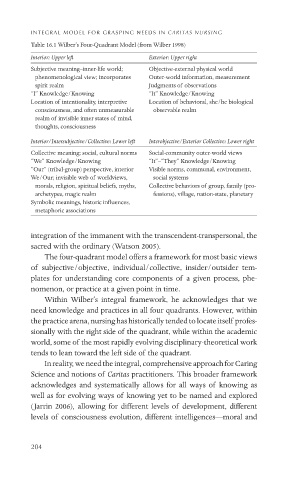
           Table 16.1 Wilber’s Four-Quadrant Model (from Wilber 1998)
           Interior: Upper left           Exterior: Upper right
           Subjective meaning–inner-life world;    Objective-external physical world
              phenomenological view; incorporates    Outer-world information, measurement
              spirit realm                Judgments of observations
           “I” Knowledge/Knowing          “It” Knowledge/Knowing
           Location of intentionality, interpretive   Location of behavioral, she/he biological
              consciousness, and often unmeasurable       observable realm
              realm of invisible inner states of mind,
              thoughts, consciousness
           Interior/Intersubjective/Collective: Lower left   Interobjective/Exterior Collective: Lower right
           Collective meaning; social, cultural norms   Social-community outer-world views
           “We” Knowledge/Knowing         “It”–“They” Knowledge/Knowing
           “Our” (tribal-group) perspective, interior    Visible norms, communal, environment,
           We/Our; invisible web of worldviews,       social systems
              morals, religion, spiritual beliefs, myths,    Collective behaviors of group, family (pro-
              archetypes, magic realm        fessions), village, nation-state, planetary
           Symbolic meanings, historic influences,
              metaphoric associations

           integration of the immanent with the transcendent-transpersonal, the
           sacred with the ordinary (Watson 2005).
              The four-quadrant model offers a framework for most basic views
           of  subjective/objective,  individual/collective,  insider/outsider  tem-
           plates for understanding core components of a given process, phe-
           nomenon, or practice at a given point in time.
              Within  Wilber’s  integral  framework,  he  acknowledges  that  we
           need knowledge and practices in all four quadrants. However, within
           the practice arena, nursing has historically tended to locate itself profes-
           sionally with the right side of the quadrant, while within the academic
           world, some of the most rapidly evolving disciplinary-theoretical work
           tends to lean toward the left side of the quadrant.
              In reality, we need the integral, comprehensive approach for Caring
           Science and notions of Caritas practitioners. This broader framework
           acknowledges and systematically allows for all ways of knowing as
           well as for evolving ways of knowing yet to be named and explored
           (Jarrin 2006), allowing for different levels of development, different
           levels of consciousness evolution, different intelligences—moral and


           204

