


Page 20 - FALL GUIDELINES MOH 2019
P. 20
EXTRINSIC
INTRINSIC
ENVIRONMENTAL NON-ENVIRONMENTAL
Postural hypotension, eg.
Drug-induced
Autonomic dysfunction
Dehydration
Joint problems
Degenerative changes,
eg osteoarthritis,
spondylosis
Inflammatory arthritis
eg rheumatoid arthritis,
psoriatic arthropathy
Charcot’s joints
Sensory deprivation
Poor vision
Loss of proprioception,
numbness of the feet
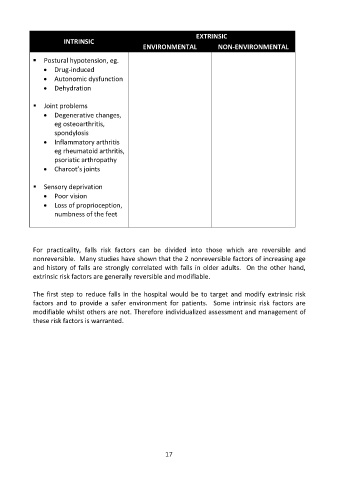
For practicality, falls risk factors can be divided into those which are reversible and
nonreversible. Many studies have shown that the 2 nonreversible factors of increasing age
and history of falls are strongly correlated with falls in older adults. On the other hand,
extrinsic risk factors are generally reversible and modifiable.
The first step to reduce falls in the hospital would be to target and modify extrinsic risk
factors and to provide a safer environment for patients. Some intrinsic risk factors are
modifiable whilst others are not. Therefore individualized assessment and management of
these risk factors is warranted.
17
17

