


Page 27 - FALL GUIDELINES MOH 2019
P. 27
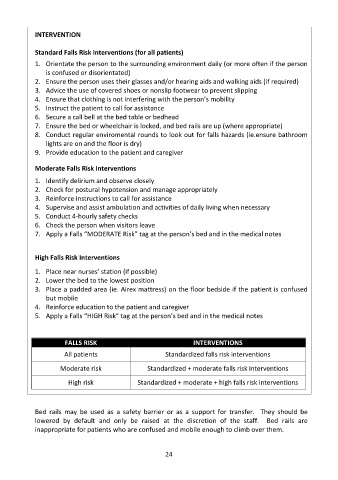
INTERVENTION
            INTERVENTION
          INTERVENTION

          INTERVENTION


          Standard Falls Risk Interventions (for all patients)
              Standard Falls Risk Interventions (for all patients)
          INTERVENTION
          Standard Falls Risk Interventions (for all patients)

          INTERVENTION
          Standard Falls Risk Interventions (for all patients)


          1. Orientate the person to the surrounding environment daily (or more often if the person
              1. Orientate the person to the surrounding environment daily (or more often if the person
          Standard Falls Risk Interventions (for all patients)
          1. Orientate the person to the surrounding environment daily (or more often if the person
            is confused or disorientated)
          Standard Falls Risk Interventions (for all patients)
          1. Orientate the person to the surrounding environment daily (or more often if the person
            is confused or disorientated)

            is confused or disorientated)
          2. Ensure the person uses their glasses and/or hearing aids and walking aids (if required)
            is confused or disorientated)
            2. Ensure the person uses their glasses and/or hearing aids and walking aids (if required)
          1. Orientate the person to the surrounding environment daily (or more often if the person
          2. Ensure the person uses their glasses and/or hearing aids and walking aids (if required)
          3. Advice the use of covered shoes or nonslip footwear to prevent slipping
          1. Orientate the person to the surrounding environment daily (or more often if the person
          2. Ensure the person uses their glasses and/or hearing aids and walking aids (if required)
          3. Advice the use of covered shoes or nonslip footwear to prevent slipping
            is confused or disorientated)
          3. Advice the use of covered shoes or nonslip footwear to prevent slipping
          4. Ensure that clothing is not interfering with the person’s mobility
            is confused or disorientated)
          3. Advice the use of covered shoes or nonslip footwear to prevent slipping
          4. Ensure that clothing is not interfering with the person’s mobility
          2. Ensure the person uses their glasses and/or hearing aids and walking aids (if required)
          4. Ensure that clothing is not interfering with the person’s mobility
          5. Instruct the patient to call for assistance
          2. Ensure the person uses their glasses and/or hearing aids and walking aids (if required)
          4. Ensure that clothing is not interfering with the person’s mobility
          5. Instruct the patient to call for assistance
          3. Advice the use of covered shoes or nonslip footwear to prevent slipping
          5. Instruct the patient to call for assistance
          6. Secure a call bell at the bed table or bedhead
          3. Advice the use of covered shoes or nonslip footwear to prevent slipping
          5. Instruct the patient to call for assistance
          6. Secure a call bell at the bed table or bedhead
          4. Ensure that clothing is not interfering with the person’s mobility
          6. Secure a call bell at the bed table or bedhead
          7. Ensure the bed or wheelchair is locked, and bed rails are up (where appropriate)
          4. Ensure that clothing is not interfering with the person’s mobility
          6. Secure a call bell at the bed table or bedhead
          7. Ensure the bed or wheelchair is locked, and bed rails are up (where appropriate)
          5. Instruct the patient to call for assistance
          7. Ensure the bed or wheelchair is locked, and bed rails are up (where appropriate)
          8. Conduct regular enviromental rounds to look out for falls hazards (ie.ensure bathroom
          5. Instruct the patient to call for assistance
          7. Ensure the bed or wheelchair is locked, and bed rails are up (where appropriate)
          8. Conduct regular enviromental rounds to look out for falls hazards (ie.ensure bathroom
          6. Secure a call bell at the bed table or bedhead
          8. Conduct regular enviromental rounds to look out for falls hazards (ie.ensure bathroom
            lights are on and the floor is dry)
          6. Secure a call bell at the bed table or bedhead
          8. Conduct regular enviromental rounds to look out for falls hazards (ie.ensure bathroom
            lights are on and the floor is dry)
          7. Ensure the bed or wheelchair is locked, and bed rails are up (where appropriate)
            lights are on and the floor is dry)
          9. Provide education to the patient and caregiver
          7. Ensure the bed or wheelchair is locked, and bed rails are up (where appropriate)
            lights are on and the floor is dry)
          9. Provide education to the patient and caregiver
          8. Conduct regular enviromental rounds to look out for falls hazards (ie.ensure bathroom
          9. Provide education to the patient and caregiver

          8. Conduct regular enviromental rounds to look out for falls hazards (ie.ensure bathroom

          9. Provide education to the patient and caregiver
            lights are on and the floor is dry)


            lights are on and the floor is dry)

          9. Provide education to the patient and caregiver

          Moderate Falls Risk Interventions
          9. Provide education to the patient and caregiver
            Moderate Falls Risk Interventions

          Moderate Falls Risk Interventions


            Moderate Falls Risk Interventions

          1. Identify delirium and observe closely
              1. Identify delirium and observe closely
          Moderate Falls Risk Interventions
          1. Identify delirium and observe closely
          2. Check for postural hypotension and manage appropriately
          Moderate Falls Risk Interventions
            2. Check for postural hypotension and manage appropriately
          1. Identify delirium and observe closely
          2. Check for postural hypotension and manage appropriately
          3. Reinforce instructions to call for assistance
            2. Check for postural hypotension and manage appropriately
          3. Reinforce instructions to call for assistance
          1. Identify delirium and observe closely
          3. Reinforce instructions to call for assistance
          4. Supervise and assist ambulation and activities of daily living when necessary
          1. Identify delirium and observe closely
          4. Supervise and assist ambulation and activities of daily living when necessary
          3. Reinforce instructions to call for assistance
          2. Check for postural hypotension and manage appropriately
          4. Supervise and assist ambulation and activities of daily living when necessary
          5. Conduct 4-hourly safety checks
          2. Check for postural hypotension and manage appropriately
          5. Conduct 4-hourly safety checks
          4. Supervise and assist ambulation and activities of daily living when necessary
          3. Reinforce instructions to call for assistance
          5. Conduct 4-hourly safety checks
          6. Check the person when visitors leave
          3. Reinforce instructions to call for assistance
          5. Conduct 4-hourly safety checks leave
          6. Check the person when visitors
          4. Supervise and assist ambulation and activities of daily living when necessary
          6. Check the person when visitors leave
          7. Apply a Falls “MODERATE Risk” tag at the person’s bed and in the medical notes
          4. Supervise and assist ambulation and activities of daily living when necessary
          6. Check the person when visitors leave
          7. Apply a Falls “MODERATE Risk” tag at the person’s bed and in the medical notes
          5. Conduct 4-hourly safety checks
          7. Apply a Falls “MODERATE Risk” tag at the person’s bed and in the medical notes

          5. Conduct 4-hourly safety checks

          7. Apply a Falls “MODERATE Risk” tag at the person’s bed and in the medical notes
          6. Check the person when visitors leave


          6. Check the person when visitors leave

          7. Apply a Falls “MODERATE Risk” tag at the person’s bed and in the medical notes

          High Falls Risk Interventions
          7. Apply a Falls “MODERATE Risk” tag at the person’s bed and in the medical notes
            High Falls Risk Interventions

          High Falls Risk Interventions

            High Falls Risk Interventions


          1. Place near nurses’ station (if possible)
            1. Place near nurses’ station (if possible)

          High Falls Risk Interventions
          1. Place near nurses’ station (if possible)
          2. Lower the bed to the lowest position
          1. Place near nurses’ station
          High Falls Risk Interventions  (if possible)
          2. Lower the bed to the lowest position

          2. Lower the bed to the lowest position
          3. Place a padded area (ie. Airex mattress) on the floor bedside if the patient is confused

          2. Lower the bed to the lowest position
          3. Place a padded area (ie. Airex mattress) on the floor bedside if the patient is confused
          1. Place near nurses’ station (if possible)
          3. Place a padded area (ie. Airex mattress) on the floor bedside if the patient is confused
            but mobile
          1. Place near nurses’ station (if possible)
          3. Place a padded area (ie. Airex mattress) on the floor bedside if the patient is confused
            but mobile
          2. Lower the bed to the lowest position
            but mobile
          4. Reinforce education to the patient and caregiver
          2. Lower the bed to the lowest position
            but mobile
          4. Reinforce education to the patient and caregiver
          3. Place a padded area (ie. Airex mattress) on the floor bedside if the patient is confused
          4. Reinforce education to the patient and caregiver
          5. Apply a Falls “HIGH Risk” tag at the person’s bed and in the medical notes
          3. Place a padded area (ie. Airex mattress) on the floor bedside if the patient is confused
          4. Reinforce education to the patient and caregiver
          5. Apply a Falls “HIGH Risk” tag at the person’s bed and in the medical notes
            but mobile
          5. Apply a Falls “HIGH Risk” tag at the person’s bed and in the medical notes

          5. Apply a Fall
            but mobile s “HIGH Risk” tag at the person’s bed and in the medical notes

          4. Reinforce education to the patient and caregiver


          4. Reinforce education to the patient and caregiver

          5. Apply a Falls “HIGH Risk” tag at the person’s bed and in the medical notes

                 FALLS RISK
                                                 INTERVENTIONS
          5. Apply a Falls “HIGH Risk” tag at the person’s bed and in the medical notes

                                                 INTERVENTIONS
                 FALLS RISK

                                                 INTERVENTIONS
                 FALLS RISK               Standardized falls risk interventions
                                                 INTERVENTIONS
                 FALLS RISK
                 All patients
                                          Standardized falls risk interventions
                 All patients
                 All patients             Standardized falls risk interventions
                                                 INTERVENTIONS
                 FALLS RISK
                                          Standardized falls risk interventions
                 All patients
                Moderate risk         Standardized + moderate falls risk interventions
                 FALLS RISK
                                                 INTERVENTIONS
                                      Standardized + moderate falls risk interventions
                Moderate risk
                                      Standardized + moderate falls risk interventions
                Moderate risk
                                          Standardized falls risk interventions
                 All patients
                Moderate risk      Standardized + moderate + high falls risk interventions
                                      Standardized + moderate falls risk interventions
                  High risk
                                          Standardized falls risk interventions
                 All patients
                  High risk
                                   Standardized + moderate + high falls risk interventions
                  High risk
                                      Standardized + moderate falls risk interventions
                                   Standardized + moderate + high falls risk interventions
                  High risk
                Moderate risk      Standardized + moderate + high falls risk interventions
                 Moderate risk        Standardized + moderate falls risk interventions
                  High risk
                                   Standardized + moderate + high falls risk interventions
                Bed rails  may  be used  as a  safety  barrier or as  a  support  for transfer.   They should be
                  High risk
                                   Standardized + moderate + high falls risk interventions
            Bed rails  may  be used  as a  safety  barrier or as  a  support  for transfer.   They should be

          Bed rails  may  be used  as a  safety  barrier or as  a  support  for transfer.   They should be
          lowered by  default  and  only be  raised at the  discretion of the  staff.    Bed  rails  are
            Bed rails  may  be used  as a  safety  barrier or as  a  support  for transfer.   They should be
            lowered by  default  and  only be  raised at the  discretion of the  staff.    Bed  rails  are
          lowered by  default  and  only be  raised at the  discretion of the  staff.    Bed  rails  are
          inappropriate for patients who are confused and mobile enough to climb over them.
          inappropriate for patients who are confused and mobile enough to climb over them.
            lowered by  default  and  only be  raised at the  discretion of the  staff.    Bed  rails  are
          Bed rails  may  be used  as a  safety  barrier or as  a  support  for transfer.   They should be
          inappropriate for patients who are confused and mobile enough to climb over them.
          Bed rails  may  be used  as a  safety  barrier or as  a  support  for transfer.   They should be
          inappropriate for patients who are confused and mobile enough to climb over them.
          lowered by  default  and  only be  raised at the  discretion of the  staff.    Bed  rails  are
          lowered by  default  and  only be  raised at the  discretion of the  staff.    Bed  rails  are
          inappropriate for patients who are confused and mobile enough to climb over them.
                                          24
                                           24
          inappropriate for patients who are confused and mobile enough to climb over them.
                                           24
                                           24
                                           24


                                           24
                                           24

