


Page 29 - FALL GUIDELINES MOH 2019
P. 29
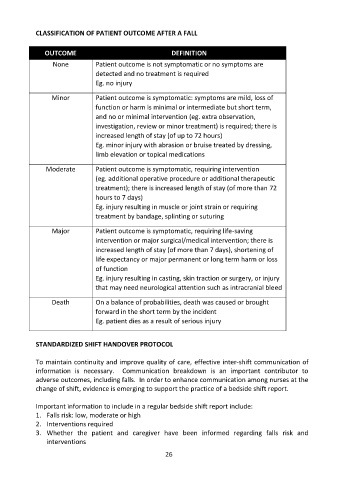
CLASSIFICATION OF PATIENT OUTCOME AFTER A FALL

          CLASSIFICATION OF PATIENT OUTCOME AFTER A FALL
             OUTCOME                        DEFINITION
            OUTCOME      Patient outcome is not symptomatic or no symptoms are
                                            DEFINITION
              None
              None       detected and no treatment is required
                         Patient outcome is not symptomatic or no symptoms are
                         Eg. no injury
                         detected and no treatment is required
                         Eg. no injury
              Minor      Patient outcome is symptomatic: symptoms are mild, loss of
              Minor      Patient outcome is symptomatic: symptoms are mild, loss of
                         function or harm is minimal or intermediate but short term,
                         function or harm is minimal or intermediate but short term,
                         and no or minimal intervention (eg. extra observation,
                         and no or minimal intervention (eg. extra observation, here is
                         investigation, review or minor treatment) is required; t
                         investigation, review or minor treatment) is required; there is
                         increased length of stay (of up to 72 hours)
                         increased length of stay (of up to 72 hours)
                         Eg. minor injury with abrasion or bruise treated by dressing,
                         limb elevation or topical medications
                         Eg. minor injury with abrasion or bruise treated by dressing,
                         limb elevation or topical medications
            Moderate     Patient outcome is symptomatic, requiring intervention
            Moderate     Patient outcome is symptomatic, requiring intervention eutic
                         (eg. additional operative procedure or additional therap
                         treatment); there is increased length of stay (of more than 72
                         (eg. additional operative procedure or additional therapeutic
                         treatment); there is increased length of stay (of more than 72
                         hours to 7 days)
                         hours to 7 days)
                         Eg. injury resulting in muscle or joint strain or requiring
                         treatment by bandage, splinting or suturing
                         Eg. injury resulting in muscle or joint strain or requiring
                         treatment by bandage, splinting or suturing
              Major      Patient outcome is symptomatic, requiring life-saving
                         intervention or major surgical/medical intervention; there is
              Major      Patient outcome is symptomatic, requiring life-saving
                         intervention or major surgical/medical intervention; there is
                         increased length of stay (of more than 7 days), shortening of
                         life expectancy or major permanent or long term harm or loss
                         increased length of stay (of more than 7 days), shortening of
                         life expectancy or major permanent or long term harm or loss
                         of function
                         of function
                         Eg. injury resulting in casting, skin traction or surgery, or injury
                         that may need neurological attention such as intracranial bleed
                         Eg. injury resulting in casting, skin traction or surgery, or injury
                         that may need neurological attention such as intracranial bleed
              Death      On a balance of probabilities, death was caused or brought
                         On a balance of probabilities, death was caused or brought
              Death      forward in the short term by the incident
                         forward in the short term by the incident
                         Eg. patient dies as a result of serious injury
                         Eg. patient dies as a result of serious injury


            STANDARDIZED SHIFT HANDOVER PROTOCOL
            STANDARDIZED SHIFT HANDOVER PROTOCOL
            To maintain continuity and improve quality of care, effective inter-shift communication of
          information is  necessary.  Communication breakdown is  an important contributor  to
          To maintain continuity and improve quality of care, effective inter-shift communication of
          information is  necessary.  Communication breakdown is  an important contributor  to
          adverse outcomes, including falls.  In order to enhance communication among nurses at the
          change of shift, evidence is emerging to support the practice of a bedside shift report.
          adverse outcomes, including falls.  In order to enhance communication among nurses at the

          change of shift, evidence is emerging to support the practice of a bedside shift report.
            Important information to include in a regular bedside shift report include:
          Important information to include in a regular bedside shift report include:
          1. Falls risk: low, moderate or high
          2. Interventions required
          1. Falls risk: low, moderate or high
          2. Interventions required
          3. Whether  the patient and caregiver have  been informed regarding  falls risk and
          3. Whether  the patient and caregiver have  been informed regarding  falls risk and
             interventions
             interventions                26

                                           26
                                           26

