


Page 20 - policy and procedure infection control
P. 20
Policies and Procedures on Infection Control
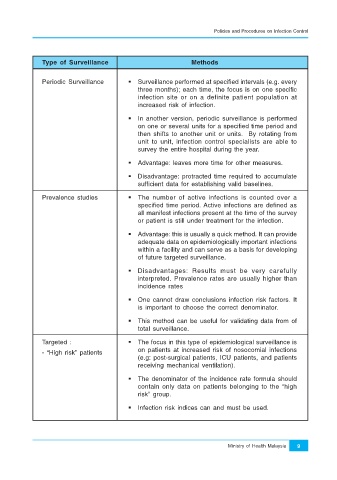
Type of Surveillance Methods
Periodic Surveillance Surveillance performed at specified intervals (e.g. every
three months); each time, the focus is on one specific
infection site or on a definite patient population at
increased risk of infection.
In another version, periodic surveillance is performed
on one or several units for a specified time period and
then shifts to another unit or units. By rotating from
unit to unit, infection control specialists are able to
survey the entire hospital during the year.
Advantage: leaves more time for other measures.
Disadvantage: protracted time required to accumulate
sufficient data for establishing valid baselines.
Prevalence studies The number of active infections is counted over a
specified time period. Active infections are defined as
all manifest infections present at the time of the survey
or patient is still under treatment for the infection.
Advantage: this is usually a quick method. It can provide
adequate data on epidemiologically important infections
within a facility and can serve as a basis for developing
of future targeted surveillance.
Disadvantages: Results must be very carefully
interpreted. Prevalence rates are usually higher than
incidence rates
One cannot draw conclusions infection risk factors. It
is important to choose the correct denominator.
This method can be useful for validating data from of
total surveillance.
Targeted : The focus in this type of epidemiological surveillance is
- “High risk” patients on patients at increased risk of nosocomial infections
(e.g: post-surgical patients, ICU patients, and patients
receiving mechanical ventilation).
The denominator of the incidence rate formula should
contain only data on patients belonging to the “high
risk” group.
Infection risk indices can and must be used.
Ministry of Health Malaysia 9

