


Page 110 - Essentials of Nursing Leadership and Management, 5th Edition
P. 110
CikguOnline
         2208_Ch07_091-102.qxd  11/6/09  5:57 PM  Page 97
                                                                   chapter 7 | Dealing With Problems and Conflicts 97      CikguOnline
                   and that her actions to resolve the conflict  clearly. Acknowledging these emotions is
                   would be supported by administration.       essential to negotiating effectively (Fiumano,
                 3. What problems am I likely to encounter? The nurse  2005). When faced with a highly charged
                   manager knew that she had allowed the problem  situation, do not respond with added emotion.
                   to go on too long. Even physicians, social work-  Take time out if you need to get your own
                   ers, and visitors to the unit were getting caught  feelings under control. Then find out why
                   up in the conflict.Team members were actively  emotions are high (watch both verbal and
                   encouraging other staff to take sides, making clear  nonverbal cues carefully) (Hart & Waisman,
                   they thought that “if you’re not with us, you’re  2005), and refocus the discussion on the issues
                   against us.”This made people from other depart-  (Shapiro & Jankowski, 1998). Without effective
                   ments very uncomfortable because they had to  leadership to prevent emotional outbursts and
                   work with both teams.The nurse manager knew  personal attacks, a mishandled negotiation can
                   that resolution of the conflict would be a relief to  worsen a situation. With effective leadership,
                   many people. It is important to ask one additional  the conflict may be resolved (Box 7-3).
                   question in preparation for negotiations:  2. Set ground rules. Members of Teams A and B
                 4. What does the other side want? In this situation,  began flinging accusations at each other as soon
                   the nurse manager was not certain what either  as the nurse manager made her statement.The
                   team really wanted. She realized that she   nurse manager stopped this quickly and said,
                   needed this information before she could begin  “First, we need to set some ground rules for this
                   to negotiate.                               discussion. Everyone will get a chance to speak
                                                               but not all at once. Please speak for yourself, not
                 Set the Stage                                 for others. And please do not make personal
                 When a conflict such as the one between Teams A  remarks or criticize your coworkers. We are here
                 and B has gone on for some time, the opposing  to resolve this problem, not to make it worse.”
                 sides are often unwilling to meet to discuss the  She had to remind the group of these ground
                 problem. If this occurs, it may be necessary to con-  rules several times during the meeting.Teaching
                 front them with direct statements designed to open  others how to negotiate can create a more col-
                 communications between the two sides to chal-  laborative environment in which the negotiation
                 lenge them to seek resolution of the situation.  will take place (Schwartz & Pogge, 2000).
                 At the same time, it is important to avoid any  3. Clarification of the problem. The nurse man-
                 implication of blame because this provokes defen-  ager wrote a list of problems raised by team
                 siveness rather than willingness to change.   members on a chalkboard. As the list grew
                   To confront Teams A and B with their behavior  longer, she asked the group, “What do you
                 toward one another, the nurse manager called them
                 together at the end of the day shift.“I am very con-
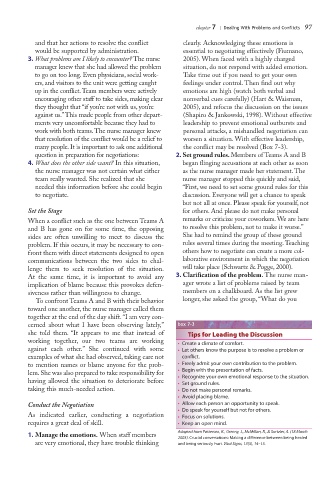
                 cerned about what I have been observing lately,”  box 7-3
                 she told them. “It appears to me that instead of  Tips for Leading the Discussion
                 working together, our two teams are working
                                                              • Create a climate of comfort.
                 against each other.” She continued with some  • Let others know the purpose is to resolve a problem or
                 examples of what she had observed, taking care not  conflict.
                 to mention names or blame anyone for the prob-  • Freely admit your own contribution to the problem.
                 lem.She was also prepared to take responsibility for  • Begin with the presentation of facts.
                                                              • Recognize your own emotional response to the situation.
                 having allowed the situation to deteriorate before
                                                              • Set ground rules.
                 taking this much-needed action.              • Do not make personal remarks.
                                                              • Avoid placing blame.
                 Conduct the Negotiation                      • Allow each person an opportunity to speak.
                                                              • Do speak for yourself but not for others.
                 As indicated earlier, conducting a negotiation  • Focus on solutions.
                 requires a great deal of skill.              • Keep an open mind.
                                                              Adapted from Patterson, K., Grenny, J., McMillan, R., & Surtzler, A. (18 March
                 1. Manage the emotions. When staff members
                                                              2003). Crucial conversations: Making a difference between being healed
                   are very emotional, they have trouble thinking  and being seriously hurt. Vital Signs, 13(5), 14–15.

