


Page 201 - Essentials of Nursing Leadership and Management, 5th Edition
P. 201
CikguOnline
         2208_Ch12_169-196.qxd  11/6/09  6:01 PM  Page 188
               188   unit 3 | Professional Issues                                                                          CikguOnline
               Staffing Ratios                              only licensed practical nurses (LPNs) but also with
                                                            unlicensed assistive personnel (UAP).The legal reg-
               Although some state nurses associations are calling
                                                            ulation of nursing practice is defined by each state
               for mandated staffing ratios, the issue is not clear-
                                                            nursing practice act; however,the ANA believes that
               cut. What has become clear is that there is no “one
                                                            “curricula for all RN programs should include con-
               size fits all”solution. In 2004 a review was conduct-
                                                            tent on supervision, delegation, assignment, and
               ed of peer-reviewed studies published between
                                                            legal aspects regarding nursing’s utilization of assis-
               1980 and 2003 of the effects of nurse staffing on
                                                            tive  personnel”  (nursingworld.org/readroom/
               patient, nurse employee, and hospital outcomes.
                                                            position/uap/uaprned).
               The literature offered no support for specific nurse-
                                                              Hospital workforce issues will continue to be
               patient ratios. However, findings from 12 key stud-
                                                            influenced by economic changes, managed care and
               ies stood out, citing specific effects of nurse staffing
                                                            insurance issues, media forces, and the nursing
               on patient outcomes: incidences of failure to rescue,
                                                            shortage. Linda Aiken has been researching rela-
               in-patient mortality, pnuemonia, urinary tract
                                                            tionships between positive patient, nurse, and
               infections, and pressure ulcers. Effects of nurse
                                                            agency outcomes and RN staffing, educational
               staffing levels on nurse employee outcomes includ-
                                                            preparation, and organizational culture (Aiken,
               ed needlestick injuries, nursing burnout, and nurs-
                                                            2002, 2004). Nurses voice disillusionment with
               ing documentation, whereas hospital length of stay,
                                                            nursing practice and decreased loyalty to organiza-
               financial outcomes, and direct nursing care were
                                                            tions. Nursing leaders in the 21st century must
               experienced by the hospital. Table 12-3 provides a
                                                            demonstrate a respect and value for their nursing
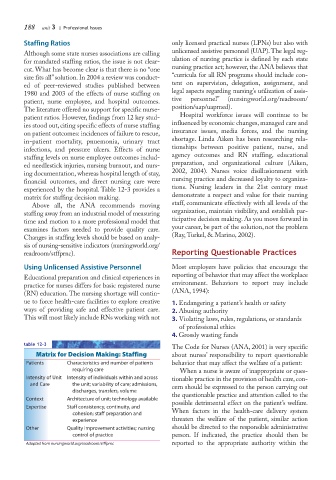
               matrix for staffing decision making.
                                                            staff, communicate effectively with all levels of the
                  Above all, the ANA recommends moving
                                                            organization, maintain visibility, and establish par-
               staffing away from an industrial model of measuring
                                                            ticipative decision making. As you move forward in
               time and motion to a more professional model that
                                                            your career, be part of the solution, not the problem
               examines factors needed to provide quality care.
                                                            (Ray, Turkel, & Marino, 2002).
               Changes in staffing levels should be based on analy-
               sis of nursing-sensitive indicators (nursingworld.org/
               readroom/stffprnc).                          Reporting Questionable Practices
               Using Unlicensed Assistive Personnel         Most employers have policies that encourage the
                                                            reporting of behavior that may affect the workplace
               Educational preparation and clinical experiences in
                                                            environment. Behaviors to report may include
               practice for nurses differs for basic registered nurse
                                                            (ANA, 1994):
               (RN) education. The nursing shortage will contin-
               ue to force health-care facilities to explore creative  1. Endangering a patient’s health or safety
               ways of providing safe and effective patient care.  2. Abusing authority
               This will most likely include RNs working with not  3. Violating laws, rules, regulations, or standards
                                                              of professional ethics
                                                            4. Grossly wasting funds
               table 12-3
                                                            The Code for Nurses (ANA, 2001) is very specific
                   Matrix for Decision Making: Staffing     about nurses’ responsibility to report questionable
                Patients    Characteristics and number of patients   behavior that may affect the welfare of a patient:
                              requiring care                  When a nurse is aware of inappropriate or ques-
                Intensity of Unit  Intensity of individuals within and across  tionable practice in the provision of health care,con-
                 and Care     the unit; variability of care; admissions,  cern should be expressed to the person carrying out
                              discharges, transfers, volume
                                                            the questionable practice and attention called to the
                Context     Architecture of unit; technology available
                                                            possible detrimental effect on the patient’s welfare.
                Expertise   Staff consistency, continuity, and
                              cohesion; staff preparation and   When factors in the health-care delivery system
                              experience                    threaten the welfare of the patient, similar action
                Other       Quality improvement activities; nursing   should be directed to the responsible administrative
                              control of practice           person. If indicated, the practice should then be
                Adapted from nursingworld.org/readroom/stffprnc  reported to the appropriate authority within the

