


Page 75 - Essentials of Nursing Leadership and Management, 5th Edition
P. 75
CikguOnline
         2208_Ch05_057-070.qxd  11/6/09  5:56 PM  Page 62
               62   unit 1 | Professional Considerations                                                                   CikguOnline
                                                            as the brains of the organization and employees as the
                                  CEO
                                                            muscle (Parker & Gadbois, 2000, p. 428).
                             Administrators                   Innovative organizations have adapted an
                                                            increasingly organic structure that is more dynamic,
                      Managers (also medical staff)
                                                            more flexible, and less centralized than the static
                              Staff nurses                  traditional hierarchical structure (Yourstone &
                                                            Smith, 2002). In these organically structured
                              Technicians
                            (including LPNs)                organizations, decisions are made by the people
                                                            who will implement them, not by their bosses.
                         Aides; housekeeping;                 The organic network emphasizes increased flex-
                              maintenance
                                                            ibility of the organizational structure, decentralized
                                                            decision making,and autonomy for working groups
               Figure 5.1 The organizational ladder.
                                                            or teams. Rigid unit structures are reorganized into
                                                            autonomous teams that consist of professionals
                                                            from different departments and disciplines. Each
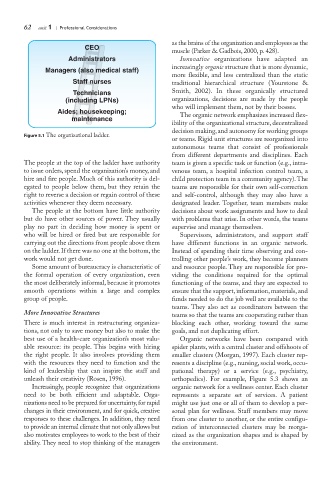
               The people at the top of the ladder have authority  team is given a specific task or function (e.g., intra-
               to issue orders, spend the organization’s money, and  venous team, a hospital infection control team, a
               hire and fire people. Much of this authority is del-  child protection team in a community agency).The
               egated to people below them, but they retain the  teams are responsible for their own self-correction
               right to reverse a decision or regain control of these  and self-control, although they may also have a
               activities whenever they deem necessary.     designated leader. Together, team members make
                  The people at the bottom have little authority  decisions about work assignments and how to deal
               but do have other sources of power. They usually  with problems that arise. In other words, the teams
               play no part in deciding how money is spent or  supervise and manage themselves.
               who will be hired or fired but are responsible for  Supervisors, administrators, and support staff
               carrying out the directions from people above them  have different functions in an organic network.
               on the ladder.If there was no one at the bottom,the  Instead of spending their time observing and con-
               work would not get done.                     trolling other people’s work, they become planners
                  Some amount of bureaucracy is characteristic of  and resource people. They are responsible for pro-
               the formal operation of every organization, even  viding the conditions required for the optimal
               the most deliberately informal, because it promotes  functioning of the teams, and they are expected to
               smooth operations within a large and complex  ensure that the support, information, materials, and
               group of people.                             funds needed to do the job well are available to the
                                                            teams. They also act as coordinators between the
               More Innovative Structures                   teams so that the teams are cooperating rather than
               There is much interest in restructuring organiza-  blocking each other, working toward the same
               tions, not only to save money but also to make the  goals, and not duplicating effort.
               best use of a health-care organization’s most valu-  Organic networks have been compared with
               able resource: its people. This begins with hiring  spider plants, with a central cluster and offshoots of
               the right people. It also involves providing them  smaller clusters (Morgan, 1997). Each cluster rep-
               with the resources they need to function and the  resents a discipline (e.g., nursing, social work, occu-
               kind of leadership that can inspire the staff and  pational therapy) or a service (e.g., psychiatry,
               unleash their creativity (Rosen, 1996).      orthopedics). For example, Figure 5.3 shows an
                  Increasingly, people recognize that organizations  organic network for a wellness center. Each cluster
               need to be both efficient and adaptable. Orga-  represents a separate set of services. A patient
               nizations need to be prepared for uncertainty,for rapid  might use just one or all of them to develop a per-
               changes in their environment, and for quick, creative  sonal plan for wellness. Staff members may move
               responses to these challenges. In addition, they need  from one cluster to another, or the entire configu-
               to provide an internal climate that not only allows but  ration of interconnected clusters may be reorga-
               also motivates employees to work to the best of their  nized as the organization shapes and is shaped by
               ability. They need to stop thinking of the managers   the environment.

