


Page 154 - ANUAL REPORT MOH 2017
P. 154
HbA1c in stipulated period. Percentage of 1 per cent reduction in HbA1c within 6 months post dietetic
             consultation was 63.5 per cent (target is 60 per cent)


             KLINIK 1MALAYSIA
             The establishment of Klinik 1Malaysia is aimed at improving accessibility of primary health care to the
             urban poor. In 2017 there are a total of 367 Klinik 1Malaysia nationwide, providing basic healthcare
             services not only to the intended target group but surrounding community as a whole. Throughout the
             year, focus has been made to enhance management of Chronic Non-Communicable Diseases (NCD)
             at Klinik 1Malaysia. A total of 83 Klinik 1Malaysia now offer such treatment. Medical Officers now serves
             in 102 Klinik 1Malaysia nationwide.

             2017 also marks a major milestone as 21 Klinik 1Malaysia were upgraded into Klinik Kesihatan. These
             were 19 Klinik 1Malaysia UTC (Urban Transformation Center), Pasir Pekan, Kelantan and Bagan Pinang,
             Port Dickson (Negeri Sembilan). With these improvements, the number of clients receiving treatment
             at Klinik 1Malaysia increased to over 6.5 million in 2017.

             CLINICAL SUPPORT SERVICES


             HUMAN RESOURCE DEVELOPMENT IN PRIMARY HEALTH CARE
             Human resource development is critical in ensuring the delivery of a comprehensive, quality and efficient
             primary health care service. Thus, continuous efforts have been made to increase the overall number of
             posts in each category, create more promotional posts and addition of new categories of professional
             staff in line with service expansion in primary care. These include allied health science professionals
             such as Medical Social Worker, Dietitian, Physiotherapist, Occupational Therapist and Optometrist.

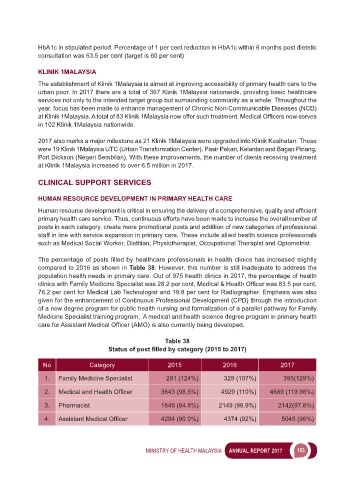
             The percentage of posts filled by healthcare professionals in health clinics has increased slightly
             compared to 2016 as shown in Table 38. However, this number is still inadequate to address the
             population health needs in primary care. Out of 975 health clinics in 2017, the percentage of health
             clinics with Family Medicine Specialist was 28.2 per cent, Medical & Health Officer was 83.5 per cent,
             76.2 per cent for Medical Lab Technologist and 19.8 per cent for Radiographer. Emphasis was also
             given for the enhancement of Continuous Professional Development (CPD) through the introduction
             of a new degree program for public health nursing and formalization of a parallel pathway for Family
             Medicine Specialist training program.  A medical and health science degree program in primary health
             care for Assistant Medical Officer (AMO) is also currently being developed.

                                                      Table 38
                                    Status of post filled by category (2015 to 2017)

               No             Category                 2015             2016               2017
               1.   Family Medicine Specialist        281 (124%)         329 (107%)         395(129%)

               2.   Medical and Health Officer      3643 (98.5%)        4929 (110%)    4689 (119.98%)

               3.   Pharmacist                      1846 (84.8%)       2149 (98.9%)       2142(97.8%)

               4.   Assistant Medical Officer       4294 (90.0%)         4374 (92%)        5045 (96%)


                                                MINISTRY OF HEALTH MALAYSIA     ANNUAL REPORT 2017       153

