


Page 194 - ANUAL REPORT MOH 2017
P. 194
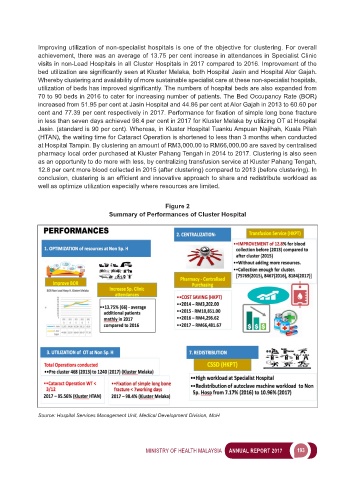
Improving utilization of non-specialist hospitals is one of the objective for clustering. For overall
             achievement, there was an average of 13.75 per cent increase in attendances in Specialist Clinic
             visits in non-Lead Hospitals in all Cluster Hospitals in 2017 compared to 2016. Improvement of the
             bed utilization are significantly seen at Kluster Melaka, both Hospital Jasin and Hospital Alor Gajah.
             Whereby clustering and availability of more sustainable specialist care at these non-specialist hospitals,
             utilization of beds has improved significantly. The numbers of hospital beds are also expanded from
             70 to 90 beds in 2016 to cater for increasing number of patients. The Bed Occupancy Rate (BOR)
             increased from 51.95 per cent at Jasin Hospital and 44.86 per cent at Alor Gajah in 2013 to 60.60 per
             cent and 77.39 per cent respectively in 2017. Performance for fixation of simple long bone fracture
             in less than seven days achieved 98.4 per cent in 2017 for Kluster Melaka by utilizing OT at Hospital
             Jasin. (standard is 90 per cent). Whereas, in Kluster Hospital Tuanku Ampuan Najihah, Kuala Pilah
             (HTAN), the waiting time for Cataract Operation is shortened to less than 3 months when conducted
             at Hospital Tampin. By clustering an amount of RM3,000.00 to RM66,000.00 are saved by centralised
             pharmacy local order purchased at Kluster Pahang Tengah in 2014 to 2017. Clustering is also seen
             as an opportunity to do more with less, by centralizing transfusion service at Kluster Pahang Tengah,
             12.8 per cent more blood collected in 2015 (after clustering) compared to 2013 (before clustering). In
             conclusion, clustering is an efficient and innovative approach to share and redistribute workload as
             well as optimize utilization especially where resources are limited.


                                                      Figure 2
                                    Summary of Performances of Cluster Hospital


             Source: Hospital Services Management Unit, Medical Development Division, MoH


                                                MINISTRY OF HEALTH MALAYSIA     ANNUAL REPORT 2017       193

