


Page 358 - alligood 8th edition_Neat
P. 358
CHAPTER 18  Dorothy E. Johnson  339


                                              Health Change Process

                                               Dynamic environment                Nursing action
                                                                                    Nurture
                                                                                    Protect
                                                                                    Stimulate
               External stressors
               (  ) or (  )


                                       Behavioral system (patient)
                                          Attachment/affiliation                   Cue


                            Dependency                         Achievement

               Stress tolerance                                             Tension
               Flexibility                   Subsystems                     Health or illness

                             Aggressive                       Sexual


                                           Ingestive/eliminative


               Internal stressors                                                   Structure
               (  ) or (  )                                                          Drive
                 Learning                                                            Set, Choice
                 Experience                                                          Behavior
                 Maturation                                                            Dynamic
                 Other changing factors                                                Equilibrium
                  (biological, psychological,                                           (Goal)
                  sociological)


                                           Active dynamic behavioral system
                                              (person, group, family)
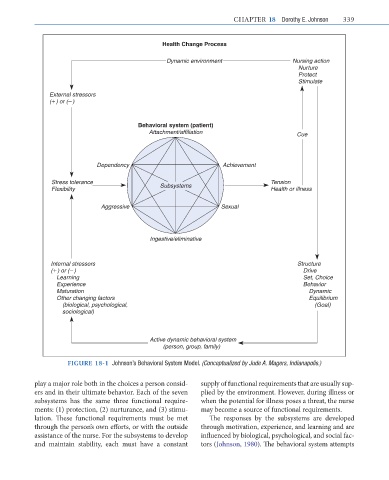
                    FIGURE 18-1   Johnson’s Behavioral System Model. (Conceptualized by Jude A. Magers, Indianapolis.)


           play a major role both in the choices a person consid-  supply of functional requirements that are usually sup-
           ers and in their ultimate behavior. Each of the seven   plied by the environment. However, during illness or
           subsystems  has  the  same  three  functional  require-  when the potential for illness poses a threat, the nurse
           ments: (1) protection, (2) nurturance, and (3) stimu-  may become a source of functional requirements.
           lation.  These  functional  requirements  must  be  met   The  responses  by  the  subsystems  are  developed
           through the person’s own efforts, or with the outside   through motivation, experience, and learning and are
           assistance of the nurse. For the subsystems to develop   influenced by biological, psychological, and social fac-
           and  maintain  stability,  each  must  have  a  constant    tors (Johnson, 1980). The behavioral system attempts

