


Page 564 - alligood 8th edition_Neat
P. 564
CHAPTER 27  Ramona T. Mercer  545

             between the family system and other social systems   system  (Mercer,  1995).  National  laws  regarding
             (Mercer, 1990).                               women  and  children  and  health  priorities  that
             The microsystem is the most influential on mater-  influence maternal role attainment are within the
               nal  role  attainment  (Mercer,  1995;  R.  Mercer,   macrosystem.
               personal communication, January 4, 2003). In   Maternal role attainment is a process that follows four
               1995,  Mercer  expanded  her  earlier  concepts   stages of role acquisition; these stages have been
               and model to emphasize the importance of the   adapted from Thornton and Nardi’s 1975 research.
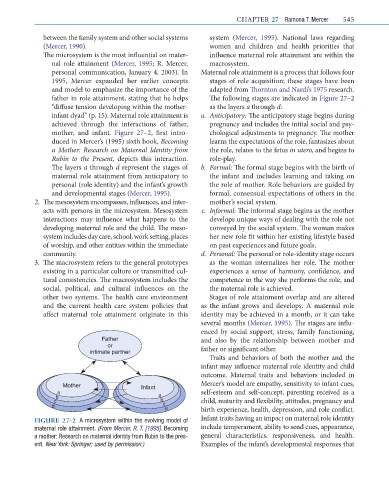
               father in role attainment, stating that he helps   The following stages are indicated in Figure 27–2
               “diffuse tension developing within the mother-  as the layers a through d:
               infant dyad” (p. 15). Maternal role attainment is     a.  Anticipatory: The anticipatory stage begins during
               achieved  through  the  interactions  of  father,   pregnancy and includes the initial social and psy-
               mother,  and  infant.  Figure  27–2,  first  intro-  chological adjustments to pregnancy. The mother
               duced in Mercer’s (1995) sixth book, Becoming   learns the expectations of the role, fantasizes about
               a  Mother:  Research  on  Maternal  Identity  from   the role, relates to the fetus in utero, and begins to
               Rubin  to  the  Present,  depicts  this  interaction.   role-play.
               The layers a through d represent the stages of    b.  Formal: The formal stage begins with the birth of
               maternal role attainment from anticipatory to   the  infant  and  includes  learning  and  taking  on
               personal (role identity) and the infant’s growth   the role of mother. Role behaviors are guided by
               and developmental stages (Mercer, 1995).    formal, consensual expectations of others in the
            2.  The mesosystem encompasses, influences, and inter-  mother’s social system.
             acts with persons in the microsystem. Mesosystem    c.  Informal: The informal stage begins as the mother
             interactions  may  influence  what  happens  to  the    develops unique ways of dealing with the role not
             developing maternal role and the child. The meso-  conveyed by the social system. The woman makes
             system includes day care, school, work setting, places   her new role fit within her existing lifestyle based
             of worship, and other entities within the immediate   on past experiences and future goals.
             community.                                    d.  Personal: The personal or role-identity stage occurs
             3.  The macrosystem refers to the general prototypes   as  the  woman  internalizes  her  role.  The  mother
             existing in a particular culture or transmitted cul-  experiences  a  sense  of  harmony,  confidence,  and
             tural consistencies. The macrosystem includes the   competence in the way she performs the role, and
             social,  political,  and  cultural  influences  on  the   the maternal role is achieved.
             other  two  systems.  The  health  care  environment   Stages of role attainment overlap and are altered
             and  the  current  health  care  system  policies  that   as  the  infant  grows  and  develops.  A  maternal  role
             affect  maternal  role  attainment  originate  in  this   identity may be achieved in a month, or it can take
                                                         several months (Mercer, 1995). The stages are influ-
                                                         enced  by  social  support,  stress,  family  functioning,
                             Father                      and  also  by  the  relationship  between  mother  and
                               or                        father or significant other.
                          intimate partner
                                                           Traits  and  behaviors  of  both  the  mother  and  the
                                                         infant may influence maternal role identity and child
                                                         outcome.  Maternal  traits  and  behaviors  included  in
                  Mother                Infant           Mercer’s model are empathy, sensitivity to infant cues,
                 a                                       self-esteem  and  self-concept,  parenting  received  as  a
                b                            a
                c                             b          child, maturity and flexibility, attitudes, pregnancy and
               d                              c d        birth experience, health, depression, and role conflict.
           FIGURE  27-2   A microsystem within the evolving model of   Infant traits having an impact on maternal role identity
           maternal role attainment. (From Mercer, R. T. [1995]. Becoming   include temperament, ability to send cues, appearance,
           a mother: Research on maternal identity from Rubin to the pres-  general  characteristics,  responsiveness,  and  health.
           ent. New York: Springer; used by permission.)  Examples of the infant’s developmental responses that

