


Page 559 - alligood 8th edition_Neat
P. 559
540    UNIT V  Middle Range Nursing Theories

           in the late 1960s. Mercer’s professor and mentor, Reva   contributed.  In  addition,  Mercer’s  work  was  influ-
           Rubin  at  the  University  of  Pittsburgh,  was  a  major   enced  by  von  Bertalanffy’s  (1968)  general  system
           stimulus for both research and theory development.   theory.  Her  model  of  maternal  role  attainment  de-
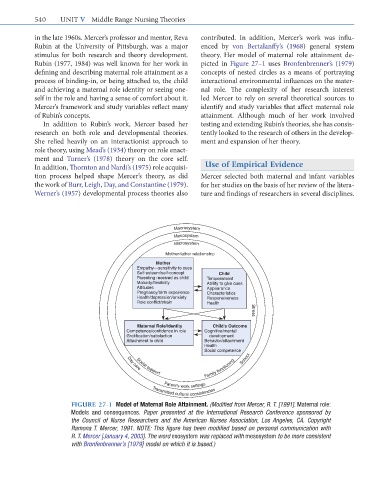
           Rubin (1977, 1984) was well known for her work in   picted  in  Figure  27–1  uses  Bronfenbrenner’s  (1979)
           defining and describing maternal role attainment as a   concepts  of  nested  circles  as  a  means  of  portraying
           process of binding-in, or being attached to, the child   interactional environmental influences on the mater-
           and achieving a maternal role identity or seeing one-  nal  role.  The  complexity  of  her  research  interest
           self in the role and having a sense of comfort about it.   led  Mercer  to  rely  on  several  theoretical  sources  to
           Mercer’s framework and study variables reflect many   identify and study variables that affect maternal role
           of Rubin’s concepts.                          attainment.  Although  much  of  her  work  involved
             In  addition  to  Rubin’s  work,  Mercer  based  her    testing and extending Rubin’s theories, she has consis-
           research  on  both  role  and  developmental  theories.   tently looked to the research of others in the develop-
           She  relied  heavily  on  an  interactionist  approach  to   ment and expansion of her theory.
           role theory, using Mead’s (1934) theory on role enact-
           ment  and  Turner’s  (1978)  theory  on  the  core  self.
           In addition, Thornton and Nardi’s (1975) role acquisi-  Use of Empirical Evidence
           tion  process  helped  shape  Mercer’s  theory,  as  did    Mercer  selected  both  maternal  and  infant  variables
           the work of Burr, Leigh, Day, and Constantine (1979).   for her studies on the basis of her review of the litera-
           Werner’s (1957) developmental process theories also   ture and findings of researchers in several disciplines.


                                                     Macrosystem
                                                     Mesosystem
                                                     Microsystem
                                               Mother-father relationship
                                                       Mother
                                       Empathy—sensitivity to cues
                                       Self-esteem/self-concept            Child
                                       Parenting received as child  Temperament
                                       Maturity/flexibility  Ability to give cues
                                       Attitudes          Appearance
                                       Pregnancy/birth experience  Characteristics
                                       Health/depression/anxiety  Responsiveness
                                       Role conflict/strain  Health    Stress

                                             Maternal Role/Identity         Child's Outcome
                                    Competence/confidence in role  Cognitive/mental
                                    Gratification/satisfaction      development
                                    Attachment to child   Behavior/attachment
                                                          Health
                                                          Social competence School
                                                          Family functioning
                                    Day care
                                       Social support
                                               Parent's work settings
                                           Transmitted cultural consistencies

                     FIGURE 27-1  Model of Maternal Role Attainment. (Modified from Mercer, R. T. [1991]. Maternal role:
                     Models  and  consequences.  Paper  presented  at  the  International  Research  Conference  sponsored  by
                     the  Council  of  Nurse  Researchers  and  the  American  Nurses  Association,  Los  Angeles,  CA.  Copyright
                     Ramona T. Mercer, 1991. NOTE: This figure has been modified based on personal communication with
                     R. T. Mercer [January 4, 2003]. The word exosystem was replaced with mesosystem to be more consistent
                     with Bronfenbrenner’s [1979] model on which it is based.)

