


Page 713 - alligood 8th edition_Neat
P. 713
694    UNIT V  Middle Range Nursing Theories

                                              The Structure of Caring

                                                                                     ( )

                                                                                         Client
                   Maintaining     Knowing             Being     Doing   Enabling        well-
                      belief                           with       for                    being


              Philosophical attitudes  Informed understanding   Message  Therapeutic   Intended
              towards persons (in  of the clinical condition (in  conveyed  actions    outcome
              general) and the desig-  general) and the situation  to client
              nated client (in specific)  and client (in specific)
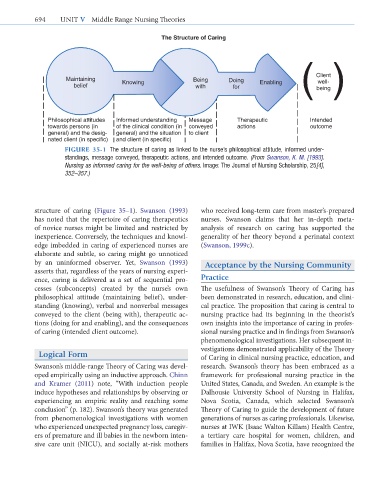
                   FIGURE  35-1  The structure of caring as linked to the nurse’s philosophical attitude, informed under-
                   standings, message conveyed, therapeutic actions, and intended outcome. (From Swanson, K. M. [1993].
                   Nursing as informed caring for the well-being of others. Image: The Journal of Nursing Scholarship, 25[4],
                   352–357.)


           structure  of  caring  (Figure  35–1).  Swanson  (1993)   who received long-term care from master’s-prepared
           has  noted  that  the  repertoire  of  caring  therapeutics    nurses.  Swanson  claims  that  her  in-depth  meta-
           of novice nurses might be limited and restricted by   analysis  of  research  on  caring  has  supported  the
           inexperience. Conversely, the techniques and knowl-  generality of her theory beyond a perinatal context
           edge  imbedded  in  caring  of  experienced  nurses  are   (Swanson, 1999c).
           elaborate  and  subtle,  so  caring  might  go  unnoticed
           by  an  uninformed  observer.  Yet,  Swanson  (1993)   Acceptance by the Nursing Community
           asserts that, regardless of the years of nursing experi-
           ence,  caring  is  delivered  as  a  set  of  sequential  pro-  Practice
           cesses  (subconcepts)  created  by  the  nurse’s  own   The  usefulness  of  Swanson’s  Theory  of  Caring  has
           philosophical  attitude  (maintaining  belief),  under-  been demonstrated in research, education, and clini-
           standing (knowing), verbal and nonverbal messages   cal practice. The proposition that caring is central to
           conveyed to the client (being with), therapeutic ac-  nursing  practice  had  its  beginning  in  the  theorist’s
           tions (doing for and enabling), and the consequences   own insights into the importance of caring in profes-
           of caring (intended client outcome).          sional nursing practice and in findings from Swanson’s
                                                         phenomenological investigations. Her subsequent in-
                                                         vestigations demonstrated applicability of the Theory
            Logical Form                                 of Caring in clinical nursing practice, education, and
           Swanson’s middle-range Theory of Caring was devel-  research.  Swanson’s  theory  has  been  embraced  as  a
           oped empirically using an inductive approach. Chinn   framework  for  professional  nursing  practice  in  the
           and  Kramer  (2011)  note,  “With  induction  people   United States, Canada, and Sweden. An example is the
           induce hypotheses and relationships by observing or   Dalhousie  University  School  of  Nursing  in  Halifax,
           experiencing  an  empiric  reality  and  reaching  some   Nova  Scotia,  Canada,  which  selected  Swanson’s
           conclusion” (p. 182). Swanson’s theory was generated   Theory of Caring to guide the development of future
           from  phenomenological  investigations  with  women   generations of nurses as caring professionals. Likewise,
           who experienced unexpected pregnancy loss, caregiv-  nurses at IWK (Isaac Walton Killam) Health Centre,
           ers of premature and ill babies in the newborn inten-  a  tertiary  care  hospital  for  women,  children,  and
           sive  care  unit  (NICU),  and  socially  at-risk  mothers   families in Halifax, Nova Scotia, have recognized the

