


Page 725 - alligood 8th edition_Neat
P. 725
706    UNIT V  Middle Range Nursing Theories

           dignity and respect (treating the patient with dignity,   identified  need  for  a  comprehensive  middle-range
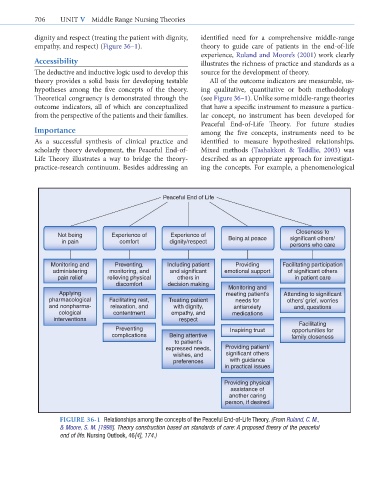
           empathy, and respect) (Figure 36–1).          theory  to  guide  care  of  patients  in  the  end-of-life
                                                         experience, Ruland and Moore’s (2001) work clearly
           Accessibility                                 illustrates the richness of practice and standards as a
           The deductive and inductive logic used to develop this   source for the development of theory.
           theory provides a solid basis for developing testable   All of the outcome indicators are measurable, us-
           hypotheses  among  the  five  concepts  of  the  theory.   ing  qualitative,  quantitative  or  both  methodology
           Theoretical congruency is demonstrated through the   (see Figure 36–1). Unlike some middle-range theories
           outcome  indicators,  all  of  which  are  conceptualized   that have a specific instrument to measure a particu-
           from the perspective of the patients and their families.  lar  concept,  no  instrument  has  been  developed  for
                                                         Peaceful  End-of-Life  Theory.  For  future  studies
           Importance                                    among  the  five  concepts,  instruments  need  to  be
           As  a  successful  synthesis  of  clinical  practice  and   identified  to  measure  hypothesized  relationships.
           scholarly  theory  development,  the  Peaceful  End-of-  Mixed  methods  (Tashakkori  &  Teddlie,  2003)  was
           Life  Theory  illustrates  a  way  to  bridge  the  theory-  described as an appropriate approach for investigat-
           practice-research  continuum.  Besides  addressing  an   ing the concepts. For example, a phenomenological


                                              Peaceful End of Life


                                                                                   Closeness to
                 Not being      Experience of   Experience of
                  in pain         comfort       dignity/respect  Being at peace   significant others/
                                                                                 persons who care
               Monitoring and    Preventing,   Including patient  Providing    Facilitating participation
                administering  monitoring, and  and significant  emotional support  of significant others
                 pain relief   relieving physical  others in                       in patient care
                                 discomfort     decision making  Monitoring and
                 Applying                                       meeting patient’s  Attending to significant
               pharmacological  Facilitating rest,  Treating patient  needs for  others’ grief, worries
               and nonpharma-   relaxation, and  with dignity,    antianxiety      and, questions
                 cological      contentment      empathy, and    medications
                interventions                      respect                          Facilitating
                                 Preventing                      Inspiring trust  opportunities for
                                complications   Being attentive                   family closeness
                                                 to patient’s
                                               expressed needs,  Providing patient/
                                                 wishes, and    significant others
                                                 preferences     with guidance
                                                               in practical issues

                                                               Providing physical
                                                                 assistance of
                                                                 another caring
                                                                person, if desired

                  FIGURE 36-1   Relationships among the concepts of the Peaceful End-of-Life Theory. (From Ruland, C. M.,
                  & Moore, S. M. [1998]. Theory construction based on standards of care: A proposed theory of the peaceful
                  end of life. Nursing Outlook, 46[4], 174.)

