


Page 84 - D&D 5e - SRD
P. 84
    The	   following	   rules	   determine	   how	   far	   a	   character
             Time                                                  or	   monster	   can	   move	   in	   a	   minute,	   an	   hour,	   or	   a	   day.
             In	   situations	   where	   keeping	   track	   of	   the	   passage	   of
             time	   is	   important,	   the	   GM	   determines	   the	   time	   a	   task	     Travel Pace
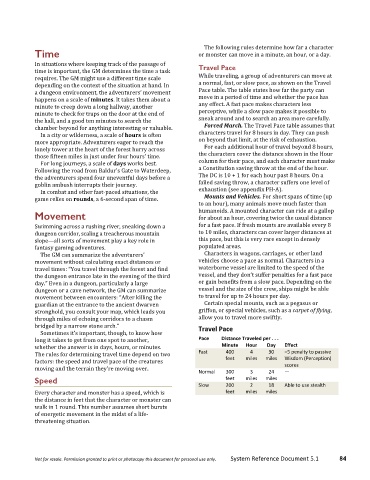
             requires.	   The	   GM	   might	   use	   a	   different	   time	   scale	     While	   traveling,	   a	   group	   of	   adventurers	   can	   move	   at
             depending	   on	   the	   context	   of	   the	   situation	   at	   hand.	   In	     a	   normal,	   fast,	   or	   slow	   pace,	   as	   shown	   on	   the	   Travel
             a	   dungeon	   environment,	   the	   adventurers’	   movement	     Pace	   table.	   The	   table	   states	   how	   far	   the	   party	   can
             happens	   on	   a	   scale	   of	   minutes.	   It	   takes	   them	   about	   a	     move	   in	   a	   period	   of	   time	   and	   whether	   the	   pace	   has
             minute	   to	   creep	   down	   a	   long	   hallway,	   another	     any	   effect.	   A	   fast	   pace	   makes	   characters	   less
             minute	   to	   check	   for	   traps	   on	   the	   door	   at	   the	   end	   of	     perceptive,	   while	   a	   slow	   pace	   makes	   it	   possible	   to
             the	   hall,	   and	   a	   good	   ten	   minutes	   to	   search	   the	     sneak	   around	   and	   to	   search	   an	   area	   more	   carefully.
             chamber	   beyond	   for	   anything	   interesting	   or	   valuable.	     	    Forced	   March.	   The	   Travel	   Pace	   table	   assumes	   that
             	    In	   a	   city	   or	   wilderness,	   a	   scale	   of	   hours	   is	   often	     characters	   travel	   for	   8	   hours	   in	   day.	   They	   can	   push
             more	   appropriate.	   Adventurers	   eager	   to	   reach	   the	     on	   beyond	   that	   limit,	   at	   the	   risk	   of	   exhaustion.
             lonely	   tower	   at	   the	   heart	   of	   the	   forest	   hurry	   across	     	    For	   each	   additional	   hour	   of	   travel	   beyond	   8	   hours,
             those	   fifteen	   miles	   in	   just	   under	   four	   hours’	   time.	     the	   characters	   cover	   the	   distance	   shown	   in	   the	   Hour
             	    For	   long	   journeys,	   a	   scale	   of	   days	   works	   best.	     column	   for	   their	   pace,	   and	   each	   character	   must	   make
             Following	   the	   road	   from	   Baldur’s	   Gate	   to	   Waterdeep,	     a	   Constitution	   saving	   throw	   at	   the	   end	   of	   the	   hour.
             the	   adventurers	   spend	   four	   uneventful	   days	   before	   a	     The	   DC	   is	   10	   +	   1	   for	   each	   hour	   past	   8	   hours.	   On	   a
             goblin	   ambush	   interrupts	   their	   journey.	     failed	   saving	   throw,	   a	   character	   suffers	   one	   level	   of
             	    In	   combat	   and	   other	   fast-   paced	   situations,	   the	     exhaustion	   (see	   appendix	   PH-   A).
             game	   relies	   on	   rounds,	   a	   6-   second	   span	   of	   time.	     	    Mounts	   and	   Vehicles.	   For	   short	   spans	   of	   time	   (up
                                                                   to	   an	   hour),	   many	   animals	   move	   much	   faster	   than
             Movement                                              humanoids.	   A	   mounted	   character	   can	   ride	   at	   a	   gallop
                                                                   for	   about	   an	   hour,	   covering	   twice	   the	   usual	   distance
             Swimming	   across	   a	   rushing	   river,	   sneaking	   down	   a	     for	   a	   fast	   pace.	   If	   fresh	   mounts	   are	   available	   every	   8
             dungeon	   corridor,	   scaling	   a	   treacherous	   mountain	     to	   10	   miles,	   characters	   can	   cover	   larger	   distances	   at
             slope—all	   sorts	   of	   movement	   play	   a	   key	   role	   in	     this	   pace,	   but	   this	   is	   very	   rare	   except	   in	   densely
             fantasy	   gaming	   adventures.	                     populated	   areas.
             	    The	   GM	   can	   summarize	   the	   adventurers’	     	    Characters	   in	   wagons,	   carriages,	   or	   other	   land
             movement	   without	   calculating	   exact	   distances	   or	     vehicles	   choose	   a	   pace	   as	   normal.	   Characters	   in	   a
             travel	   times:	   “You	   travel	   through	   the	   forest	   and	   find	     waterborne	   vessel	   are	   limited	   to	   the	   speed	   of	   the
             the	   dungeon	   entrance	   late	   in	   the	   evening	   of	   the	   third	     vessel,	   and	   they	   don’t	   suffer	   penalties	   for	   a	   fast	   pace
             day.”	   Even	   in	   a	   dungeon,	   particularly	   a	   large	     or	   gain	   benefits	   from	   a	   slow	   pace.	   Depending	   on	   the
             dungeon	   or	   a	   cave	   network,	   the	   GM	   can	   summarize	     vessel	   and	   the	   size	   of	   the	   crew,	   ships	   might	   be	   able
             movement	   between	   encounters:	   “After	   killing	   the	     to	   travel	   for	   up	   to	   24	   hours	   per	   day.
             guardian	   at	   the	   entrance	   to	   the	   ancient	   dwarven	     	    Certain	   special	   mounts,	   such	   as	   a	   pegasus	   or
             stronghold,	   you	   consult	   your	   map,	   which	   leads	   you	     griffon,	   or	   special	   vehicles,	   such	   as	   a	   carpet	   of	   flying,
             through	   miles	   of	   echoing	   corridors	   to	   a	   chasm	     allow	   you	   to	   travel	   more	   swiftly.
             bridged	   by	   a	   narrow	   stone	   arch.”	      Travel	   Pace
             	    Sometimes	   it’s	   important,	   though,	   to	   know	   how
             long	   it	   takes	   to	   get	   from	   one	   spot	   to	   another,	     Pace	     Distance	   Traveled	   per	   .	   .	   .
             whether	   the	   answer	   is	   in	   days,	   hours,	   or	   minutes.	     Minute	     Hour	     Day	     Effect
             The	   rules	   for	   determining	   travel	   time	   depend	   on	   two	     Fast	     400	     4	     30	     −5	   penalty	   to	   passive
             factors:	   the	   speed	   and	   travel	   pace	   of	   the	   creatures	     feet	     miles	     miles	     Wisdom	   (Perception)
             moving	   and	   the	   terrain	   they’re	   moving	   over.	                    scores
                                                                   Normal	     300	     3	     24	     —
             Speed                                                          feet	     miles	     miles
                                                                   Slow	     200	     2	     18	     Able	   to	   use	   stealth
             Every	   character	   and	   monster	   has	   a	   speed,	   which	   is	     feet	     miles	     miles
             the	   distance	   in	   feet	   that	   the	   character	   or	   monster	   can
             walk	   in	   1	   round.	   This	   number	   assumes	   short	   bursts
             of	   energetic	   movement	   in	   the	   midst	   of	   a	   life-
             threatening	   situation.


Not for resale. Permission granted to print or photocopy this document for personal use only. System Reference Document 5.1 84 

