


Page 103 - Participant Manual
P. 103
Internal Bleeding


                Internal bleeding (bleeding that occurs inside the body, into a body cavity or space) can be a consequence
                of traumatic injury and may be life threatening. Blunt trauma, which is caused by impact with a flat object
                or surface, is a common cause of internal bleeding. Mechanisms of injury that can lead to blunt trauma and
                internal bleeding include falls, being struck by a vehicle or a piece of heavy equipment, being struck by a blunt
                object (such as a bat) or being thrown into a blunt object (such as a steering wheel). Crushing forces (for
                example, when a person’s body is squeezed between two hard surfaces) can also cause blunt trauma, leading
                to internal bleeding. Penetrating trauma, which occurs when the body is pierced by a sharp, narrow object
                (such as a knife or bullet) or impaled on a sharp object (such as a branch or piece of metal), can also lead to
                internal bleeding.
                Internal bleeding may not be immediately obvious because the blood is contained within the body (e.g.,
                within the abdomen, chest or skull). Often, when a person has sustained an injury that could cause internal
                bleeding, he or she will have other, more obvious injuries as well. When this is the case, medical treatment is
                usually sought for the more obvious injuries, and the internal bleeding is discovered while the person is being
                assessed by medical personnel. However, internal bleeding can also occur as a result of seemingly minor
                trauma, and it may reveal itself hours or days after the initial injury. When the mechanism of injury is one that
                could lead to internal bleeding (such as blunt or penetrating trauma), be alert to signs and symptoms that may
                indicate internal bleeding.

                Signs and Symptoms of Internal Bleeding


                As a result of the blood loss, the person may show signs and symptoms of shock, such as excessive thirst;
                skin that feels cool or moist and looks pale or bluish; an altered level of consciousness; and a rapid, weak
                heartbeat. The person may cough or vomit blood. You may also notice that the area of the body where the
                blood is collecting (such as the abdomen) is tender, swollen or rigid, and there may be bruising over the area.
                If internal bleeding is occurring in an injured limb, the limb may be blue or extremely pale, swollen and rigid.


                First Aid Care for Internal Bleeding

                If a person is showing signs and symptoms of internal bleeding, call 9-1-1 or the designated emergency
                number immediately, if you have not already done so. If necessary, give first aid care for shock until help arrives.


                Wounds
     © 2011, 2016 The American National Red Cross. All rights reserved.

                A wound is an injury that results when the skin
                or other tissues of the body are damaged.
                Wounds are generally classified as closed or open.

                Closed Wounds


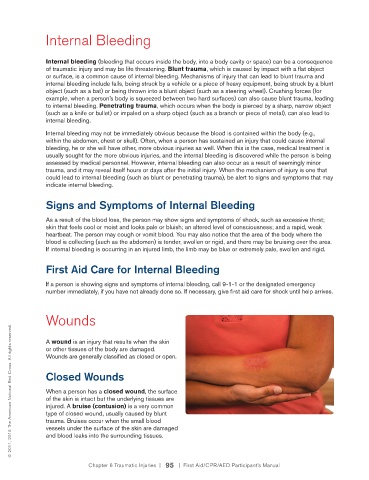
                When a person has a closed wound, the surface
                of the skin is intact but the underlying tissues are
                injured. A bruise (contusion) is a very common
                type of closed wound, usually caused by blunt
                trauma. Bruises occur when the small blood
                vessels under the surface of the skin are damaged
                and blood leaks into the surrounding tissues.


 Chapter 6 Traumatic Injuries  |   94   |  First Aid/CPR/AED Participant’s Manual  Chapter 6 Traumatic Injuries  |   95   |  First Aid/CPR/AED Participant’s Manual

