


Page 160 - Year 3 SOW (2020)
P. 160
Primary Year 3 SK Scheme of Work
                                                          SCHEME OF WORK: TEXTBOOK BASED LESSON (Unit 3)


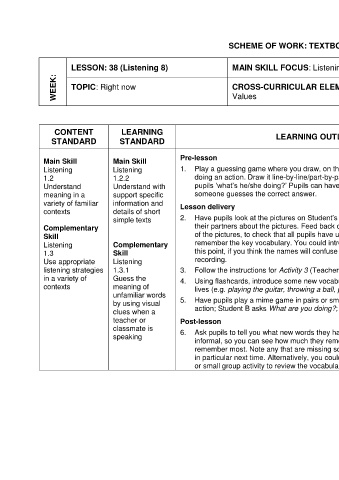
                   LESSON: 38 (Listening 8)                MAIN SKILL FOCUS: Listening                  THEME: World of Self, Family and Friends
               WEEK:    TOPIC: Right now                   CROSS-CURRICULAR ELEMENT: Language;          LANGUAGE/GRAMMAR FOCUS: Present continuous

                                                           Values
                                                                                                        questions (be + -ing)


               CONTENT         LEARNING                                                                              MATERIALS /        DIFFERENTIATION
              STANDARD         STANDARD                               LEARNING OUTLINE                              REFERENCES             STRATEGIES
                                              Pre-lesson
            Main Skill       Main Skill                                                                            Get Smart plus 3   Differentiate learning
            Listening        Listening        1.  Play a guessing game where you draw, on the board, a picture of a person   Student’s Book,   according to the needs of
            1.2              1.2.2               doing an action. Draw it line-by-line/part-by-part and after each line/part ask   p.27   your pupils and class. Please
            Understand       Understand with     pupils ‘what’s he/she doing?’ Pupils can have one guess each time until              see the seven differentiation
            meaning in a     support specific    someone guesses the correct answer.                               Teacher’s Book,    strategies listed in the
            variety of familiar   information and   Lesson delivery                                                p.49               introduction. Please also
            contexts         details of short                                                                      Flashcards for new   consider the following:
                             simple texts     2.  Have pupils look at the pictures on Student’s Book, p.27. They should talk to   vocabulary    Decide how many, and
            Complementary                        their partners about the pictures. Feed back on this by eliciting details about all   which, new words/phrases to
            Skill                                of the pictures, to check that all pupils have understood the pictures and           introduce depending on your
            Listening        Complementary       remember the key vocabulary. You could introduce the characters’ names at            pupils’ performance in the
            1.3                  Skill           this point, if you think the names will confuse pupils when they hear the            lesson so far. It shouldn’t be
            Use appropriate   Listening          recording.                                                                           more than four or five, even
            listening strategies   1.3.1             3.  Follow the instructions for Activity 3 (Teacher’s Book, p.49).               with more proficient pupils.
            in a variety of   Guess the       4.  Using flashcards, introduce some new vocabulary that is relevant to your pupils’
            contexts         meaning of          lives (e.g. playing the guitar, throwing a ball, playing badminton).
                             unfamiliar words
                             by using visual   5.  Have pupils play a mime game in pairs or small groups. Student A mimes an
                             clues when a        action; Student B asks What are you doing?; Student A says I’m xxxing xxx.
                             teacher or       Post-lesson
                             classmate is     6.  Ask pupils to tell you what new words they have learned today. Keep this
                             speaking            informal, so you can see how much they remember and which pupils seem to

                                                 remember most. Note any that are missing so that you can review these words
                                                 in particular next time. Alternatively, you could design a short, fun speaking pair
                                                 or small group activity to review the vocabulary from this lesson.


                                                                                                                                                         81

