


Page 289 - Year 3 SOW (2020)
P. 289
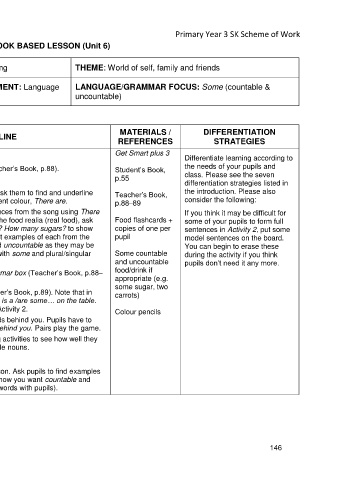
Primary Year 3 SK Scheme of Work
 SCHEME OF WORK: TEXTBOOK BASED LESSON (Unit 6)


 LESSON: 82 (Speaking 16)   MAIN SKILL FOCUS: Speaking    THEME: World of self, family and friends
 WEEK:    TOPIC: Food, please!   CROSS-CURRICULAR ELEMENT: Language    LANGUAGE/GRAMMAR FOCUS: Some (countable &

                    uncountable)


 CONTENT   LEARNING            MATERIALS /          DIFFERENTIATION
 STANDARD   STANDARD   LEARNING OUTLINE   REFERENCES   STRATEGIES
       Pre-lesson             Get Smart plus 3
 Main Skill   Main Skill                       Differentiate learning according to
 Speaking 2.1   Speaking 2.1.5   1.  Play the TPR game (see TPR activity, Teacher’s Book, p.88).   Student’s Book,   the needs of your pupils and
 Communicate   Describe people   Lesson delivery   p.55   class. Please see the seven
 simple information   and objects using        differentiation strategies listed in
 intelligibly   suitable words and   2.  Ask pupils to read the words of the song. Ask them to find and underline   Teacher’s Book,   the introduction. Please also
    phrases   with a colour pencil There’s and, in a different colour, There are.    p.88–89   consider the following:
 Complementary      3.  Ask pupils to tell you some example sentences from the song using There      If you think it may be difficult for
 Skill   Complementary   is/are and write them on the board. Using the food realia (real food), ask   Food flashcards +   some of your pupils to form full
 Listening 1.2    Skill   questions like How many carrots are there? How many sugars? to show   copies of one per   sentences in Activity 2, put some
 Understand   Listening 1.2.2    that words like sugar are uncountable. Elicit examples of each from the   pupil   model sentences on the board.
 meaning in a   Understand with   song. Avoid using words like countable and uncountable as they may be      You can begin to erase these
 variety of familiar   support specific   confusing. Show how each goes together with some and plural/singular   Some countable   during the activity if you think
 contexts   information and   noun.   and uncountable   pupils don’t need it any more.
    details of short   4.  Modify and follow the instructions for Grammar box (Teacher’s Book, p.88–  food/drink if
 simple texts   9) as necessary.   appropriate (e.g.

 5.  Follow the instructions for Activity 2 (Teacher’s Book, p.89). Note that in   some sugar, two
                              carrots)
 pairs, Pupil A says a sentence using There is a /are some… on the table.
 Pupil B listens and points to the picture in Activity 2.   Colour pencils
 6.  Play a game where you hide food flashcards behind you. Pupils have to
 guess what you have, There’s some milk behind you. Pairs play the game.
 Monitor carefully as pupils do the Speaking activities to see how well they
 have understood countable and uncountable nouns.
 Post-lesson
 7.  Return to the table/mind map from last lesson. Ask pupils to find examples
 of different nouns on it (give examples to show you want countable and
 uncountable nouns, but avoid using these words with pupils).


                                                                    146

