


Page 291 - Year 3 SOW (2020)
P. 291
Primary Year 3 SK Scheme of Work
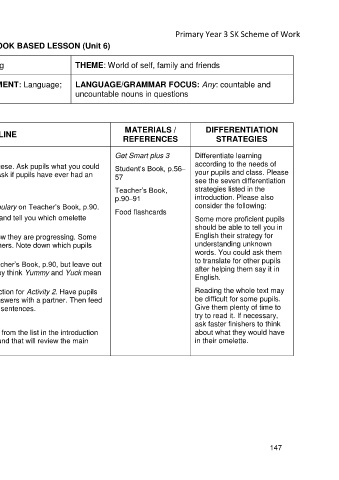
 SCHEME OF WORK: TEXTBOOK BASED LESSON (Unit 6)

 LESSON: 83 (Reading 16)   MAIN SKILL FOCUS: Reading   THEME: World of self, family and friends
 WEEK:    TOPIC: Food, please!   CROSS-CURRICULAR ELEMENT: Language;   LANGUAGE/GRAMMAR FOCUS: Any: countable and


 Creativity & Innovation
                    uncountable nouns in questions


 CONTENT   LEARNING             MATERIALS /         DIFFERENTIATION
 STANDARD   STANDARD   LEARNING OUTLINE   REFERENCES   STRATEGIES

 Main Skill   Main Skill   Pre-lesson   Get Smart plus 3   Differentiate learning
 Reading 3.2   Reading 3.2.3           1.  Introduce the flashcards for eggs, milk, cheese. Ask pupils what you could   Student’s Book, p.56–  according to the needs of
 Understand a   Guess the meaning   make with these. Elicit or teach omelette. Ask if pupils have ever had an   57   your pupils and class. Please
 variety of linear   of unfamiliar words   omelette. If so, what was inside it?   see the seven differentiation
 and non-linear   from clues provided   Lesson delivery   Teacher’s Book,   strategies listed in the
 print and digital   by visuals and the   p.90–91   introduction. Please also
 texts by using   topic   2.  Follow instructions for Warm up and Vocabulary on Teacher’s Book, p.90.   Food flashcards   consider the following:
 appropriate      3.  Introduce the text and ask pupils to read it and tell you which omelette   Some more proficient pupils
 reading strategies      they’d prefer.          should be able to tell you in
    Complementary   Monitor carefully as pupils read and see how they are progressing. Some   English their strategy for
    Skill   pupils may read much more slowly than others. Note down which pupils   understanding unknown
 Complementary   Reading 3.2.2    finish quickly and which take longer.   words. You could ask them
 Skill   Understand specific                     to translate for other pupils
 Reading 3.2   information and   4.  Follow the instructions for Activity 1 on Teacher’s Book, p.90, but leave out   after helping them say it in
 Understand a   details of short   the performance stage. Ask pupils what they think Yummy and Yuck mean   English.
 variety of linear   simple texts   and why they think that.
 and non-linear   5.  To follow on from the reading, follow instruction for Activity 2. Have pupils   Reading the whole text may
 print and digital   do this individually before checking their answers with a partner. Then feed   be difficult for some pupils.
 texts by using   back, and elicit language from pupils in full sentences.   Give them plenty of time to
 appropriate   Post-lesson                       try to read it. If necessary,
 reading strategies                              ask faster finishers to think
    6.  Choose an appropriate post-lesson activity from the list in the introduction   about what they would have
 that suits your pupils’ needs and interests and that will review the main   in their omelette.
 areas covered in the lesson.


                                                                    147

