


Page 313 - Year 3 SOW (2020)
P. 313
Primary Year 3 SK Scheme of Work
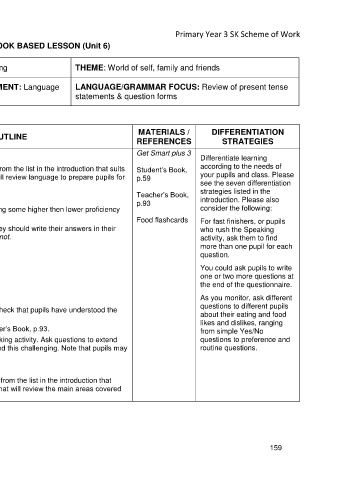
 SCHEME OF WORK: TEXTBOOK BASED LESSON (Unit 6)


 LESSON: 92 (Speaking 18)   MAIN SKILL FOCUS: Speaking    THEME: World of self, family and friends
 WEEK:    TOPIC: Food, please!   CROSS-CURRICULAR ELEMENT: Language    LANGUAGE/GRAMMAR FOCUS: Review of present tense

                    statements & question forms


 CONTENT   LEARNING                MATERIALS /        DIFFERENTIATION
 STANDARD   STANDARD   LEARNING OUTLINE   REFERENCES    STRATEGIES
       Pre-lesson                  Get Smart plus 3
 Main Skill   Main Skill                           Differentiate learning
 Speaking 2.1   Speaking 2.1.2             1.  Choose an appropriate pre-lesson activity from the list in the introduction that suits   Student’s Book,   according to the needs of
 Communicate   Find out about and   your pupils’ needs and interests and that will review language to prepare pupils for   p.59   your pupils and class. Please
 simple information   describe basic   the lesson.      see the seven differentiation
 intelligibly   everyday routines   Lesson delivery   Teacher’s Book,   strategies listed in the
                                   p.93            introduction. Please also
       2.  Use flashcards to review questions by asking some higher then lower proficiency      consider the following:
 Complementary   Complementary   pupils about their food likes and dislikes.   Food flashcards   For fast finishers, or pupils
 Skill   Skill   3.  Tell pupils you will ask some questions. They should write their answers in their   who rush the Speaking
 Listening 1.2    Listening 1.2.5    notebooks. Answers – Yes, I do. / No, I do not.   activity, ask them to find
 Understand   Understand a wide   Questions:       more than one pupil for each
 meaning in a   range of short                     question.
 variety of familiar   supported   Do you have pancakes for breakfast?
 contexts   questions   Do you like cheeseburgers?   You could ask pupils to write
    Do you like yoghurt?                           one or two more questions at
 Do you have soup for dinner?                      the end of the questionnaire.
 Do you want a crepe for lunch?                    As you monitor, ask different
 Do brief feed back at this point, to double check that pupils have understood the   questions to different pupils
                                                   about their eating and food
 questions and the vocabulary.                     likes and dislikes, ranging
 4.  Follow the instructions for Activity 4, Teacher’s Book, p.93.   from simple Yes/No
 Monitor closely as pupils work on the Speaking activity. Ask questions to extend   questions to preference and
 pupils’ language or to support those who find this challenging. Note that pupils may   routine questions.
 not find a name to put in all of the squares.
 Post-lesson
 5.  Choose an appropriate post-lesson activity from the list in the introduction that
 suits your pupils’ needs and interests and that will review the main areas covered
 in the lesson.


                                                                    159

