


Page 356 - Year 3 SOW (2020)
P. 356
Primary Year 3 SK Scheme of Work
 SCHEME OF WORK: TEXTBOOK BASED LESSON (Unit 7)

 LESSON: 111 (Language Arts 21)   MAIN SKILL FOCUS: Language Arts   THEME: World of Stories
 WEEK:    TOPIC: Out and about   CROSS-CURRICULAR ELEMENT: Values    LANGUAGE/GRAMMAR FOCUS: Imperative statements


                    (positive & negative)

 CONTENT   LEARNING   LEARNING OUTLINE   MATERIALS /   DIFFERENTIATION
 STANDARD   STANDARD               REFERENCES          STRATEGIES

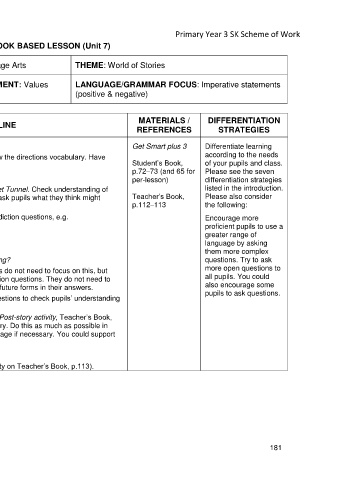
 Main Skill   Main Skill   Pre-lesson   Get Smart plus 3   Differentiate learning
 1.
 Language Arts 5.2          Language Arts 5.2.1                 Play the song from Student’s Book p.65 to review the directions vocabulary. Have      according to the needs
 Express personal   Ask and answer   pupils sing along and/or do the actions.   Student’s Book,   of your pupils and class.
 responses to   simple questions   Lesson delivery   p.72–73 (and 65 for   Please see the seven
 literary texts   about characters,   per-lesson)    differentiation strategies
    actions and events of   2.  Tell pupils they will read a story called The Secret Tunnel. Check understanding of      listed in the introduction.
    interest in a text    secret and tunnel. Introduce the characters and ask pupils what they think might   Teacher’s Book,   Please also consider
 Complementary      happen in the story.   p.112–113   the following:
 Skill      3.  Read the story to pupils. As you do that, ask prediction questions, e.g.      Encourage more
 Speaking 2.1   Complementary   What do you think is going to happen next?   proficient pupils to use a
 Communicate   Skill                                greater range of
 simple information   Speaking 2.1.4  Ask   Will they go to the park today?   language by asking
 intelligibly   about, make and   What will they find in the park?   them more complex
    respond to simple   Do you think the tunnel will be scary/dark/long?   questions. Try to ask
 predictions    Note that the questions use future will. The pupils do not need to focus on this, but   more open questions to
                                                    all pupils. You could
 should understand that the questions are prediction questions. They do not need to
 answer in full sentences and do not need to use future forms in their answers.   also encourage some
 4.  Play the recording of the story and ask some questions to check pupils’ understanding   pupils to ask questions.
 of it (see Teacher’s Book, p.112 After reading).
 5.  Talk to pupils about the Values in the story (see Post-story activity, Teacher’s Book,
 p.113) and ask them for their reactions to the story. Do this as much as possible in
 English, but allow pupils to talk in their first language if necessary. You could support
 or translate into English.
 Post-lesson
 6.  Play the Line Jumping game (see Optional activity on Teacher’s Book, p.113).


                                                                    181

