


Page 382 - Year 3 SOW (2020)
P. 382
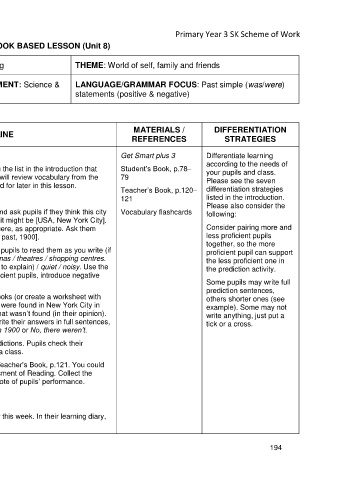
Primary Year 3 SK Scheme of Work
 SCHEME OF WORK: TEXTBOOK BASED LESSON (Unit 8)

 LESSON: 120 (Reading 23)   MAIN SKILL FOCUS: Reading    THEME: World of self, family and friends
 WEEK:    TOPIC: Where were you yesterday?   CROSS-CURRICULAR ELEMENT: Science &   LANGUAGE/GRAMMAR FOCUS: Past simple (was/were)


 Technology
                    statements (positive & negative)


 CONTENT   LEARNING               MATERIALS /         DIFFERENTIATION
 STANDARD   STANDARD   LEARNING OUTLINE   REFERENCES     STRATEGIES

 Main Skill   Main Skill   Pre-lesson   Get Smart plus 3   Differentiate learning
 Reading 3.2   Reading 3.2.2   1.  Choose an appropriate pre-lesson activity from the list in the introduction that   Student’s Book, p.78–  according to the needs of
 Understand a   Understand   suits your pupils’ needs and interests and that will review vocabulary from the   79   your pupils and class.
 variety of linear   specific   previous lesson, leaving the words on the board for later in this lesson.   Please see the seven
 and non-linear   information and   Teacher’s Book, p.120–  differentiation strategies
 print and digital   details of short   Lesson delivery   121   listed in the introduction.
 texts by using   simple texts   2.  Show the pictures from Student’s Book, p.78 and ask pupils if they think this city   Vocabulary flashcards    Please also consider the
 appropriate      is in Malaysia [No]. Ask them where they think it might be [USA, New York City].   following:
 reading strategies      Find out if pupils know this city or have been there, as appropriate. Ask them      Consider pairing more and
       when they think the pictures were taken [in the past, 1900].    less proficient pupils
    Complementary                                   together, so the more
 Complementary   Skill   3.  Write key words in a list on the board, and ask pupils to read them as you write (if   proficient pupil can support
 Skill   Writing 4.2.2     not already there from pre-lesson stage): cinemas / theatres / shopping centres.   the less proficient one in
 Writing 4.2   Make and give   Add cars / horses / carriages (show flashcards to explain) / quiet / noisy. Use the   the prediction activity.
 Communicate   reasons for   words to elicit some sentences from more proficient pupils, introduce negative
 basic information   simple   wasn’t/weren’t.       Some pupils may write full
 intelligibly for a   predictions   4.  Ask pupils to put the vocabulary in their notebooks (or create a worksheet with   prediction sentences,
 range of purposes   these words). Ask pupils which of these things were found in New York City in   others shorter ones (see
 in print and digital   1900 – they should tick what was and cross what wasn’t found (in their opinion).   example). Some may not
 media   Pupils work in pairs to make predictions and write their answers in full sentences,   write anything, just put a
                                                    tick or a cross.
 e.g. There weren’t any cars in New York City in 1900 or No, there weren’t.

 5.  Have pupils read the texts and check their predictions. Pupils check their
 answers with their partner. Check answers as a class.
 6.  Ask pupils to work on their own on Activity 2, Teacher’s Book, p.121. You could
 use this as a classroom-based informal assessment of Reading. Collect the
 books after the activity to review and make a note of pupils’ performance.
 Post-lesson
 7.  Learning diaries:
 Ask pupils to think back on their learning so far this week. In their learning diary,
 they can write:


                                                                    194

