


Page 458 - Year 3 SOW (2020)
P. 458
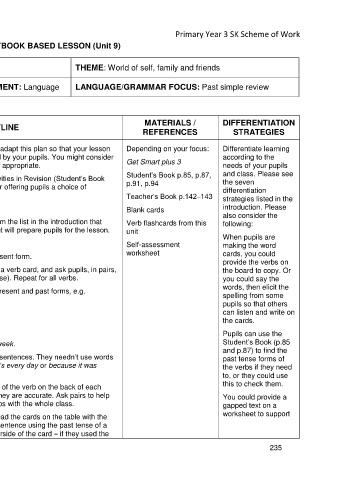
Primary Year 3 SK Scheme of Work
 SCHEME OF WORK: NON-TEXTBOOK BASED LESSON (Unit 9)

 WEEK:    LESSON: 144 (Language Awareness 8)   MAIN SKILL FOCUS: Writing    THEME: World of self, family and friends


 TOPIC: On holiday
 CROSS-CURRICULAR ELEMENT: Language
                    LANGUAGE/GRAMMAR FOCUS: Past simple review


 CONTENT   LEARNING   LEARNING OUTLINE   MATERIALS /    DIFFERENTIATION
 STANDARD   STANDARD                REFERENCES             STRATEGIES

 Main Skill   Main Skill   Use your notes made on pupils during this unit to adapt this plan so that your lesson   Depending on your focus:   Differentiate learning
 Writing 4.2   Writing 4.2.4   consolidates and extends language areas needed by your pupils. You might consider   Get Smart plus 3   according to the
 Communicate   Describe people   using some of the material as a homework task, if appropriate.   needs of your pupils
 basic information  and objects using   Note: You could also make use of the review activities in Revision (Student’s Book   Student’s Book p.85, p.87,   and class. Please see
 intelligibly for a   suitable words and   p.94 / Teacher’s Book p.142–143) and/or consider offering pupils a choice of   p.91, p.94   the seven
 range of   phrases   activities.   Teacher’s Book p.142–143    differentiation
 purposes in print                                      strategies listed in the
 and digital media     Pre-lesson   Blank cards         introduction. Please
    Complementary   1.  Choose an appropriate pre-lesson activity from the list in the introduction that   Verb flashcards from this   also consider the
    Skill   suits your pupils’ needs and interests and that will prepare pupils for the lesson.   unit   following:
 Complementary  Listening 1.2.5                         When pupils are
 Skill   Understand a wide   Lesson delivery   Self-assessment   making the word
 Listening 1.2   range of short   2.  Use the flashcards to review key verbs in present form.     worksheet   cards, you could
 Understand   supported                                 provide the verbs on
 meaning in a   questions   3.  Hand out sets of blank cards to pupils. Show a verb card, and ask pupils, in pairs,   the board to copy. Or
 variety of familiar   to write the verb on a blank card (present tense). Repeat for all verbs.    you could say the
 contexts                                               words, then elicit the
    4.  Write sentences on the board to show both present and past forms, e.g.   spelling from some
 I go to school at 8 o’clock every day.                 pupils so that others
                                                        can listen and write on
 Yesterday, I went to school at 8 o’clock.              the cards.
 Hana doesn’t like cheese.                              Pupils can use the

 Ali didn’t like the film at the cinema last week.      Student’s Book (p.85
                                                        and p.87) to find the
 5.  Ask pupils why we use go and went in these sentences. They needn’t use words   past tense forms of
 like ‘past’ or ‘present’, but can say because it’s every day or because it was   the verbs if they need
 yesterday. Explain that it’s in the past.              to, or they could use
 6.  Ask pupils in their pairs to write the past form of the verb on the back of each   this to check them.
 card.  Monitor and help pupils, making sure they are accurate. Ask pairs to help   You could provide a
 each other if necessary and/or check the verbs with the whole class.   gapped text on a
 7.  Pairs play a game with their cards. They spread the cards on the table with the   worksheet to support
 present form up. In turns, they should say a sentence using the past tense of a
 verb they can see. Then they check the underside of the card – if they used the

                                                                    235

