


Page 484 - Year 3 SOW (2020)
P. 484
Primary Year 3 SK Scheme of Work
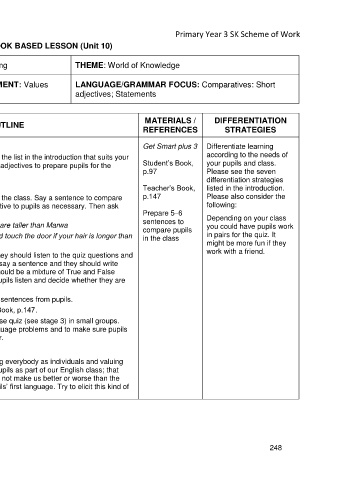
 SCHEME OF WORK: TEXTBOOK BASED LESSON (Unit 10)

 LESSON: 151 (Speaking 29)   MAIN SKILL FOCUS: Speaking   THEME: World of Knowledge
 WEEK:    TOPIC: The world around us   CROSS-CURRICULAR ELEMENT: Values   LANGUAGE/GRAMMAR FOCUS: Comparatives: Short


                    adjectives; Statements

 CONTENT   LEARNING   LEARNING OUTLINE   MATERIALS /   DIFFERENTIATION
 STANDARD   STANDARD                REFERENCES           STRATEGIES

 Main Skill   Main Skill   Pre-lesson   Get Smart plus 3   Differentiate learning
 Speaking 2.1   Speaking 2.1.5   1.  Choose an appropriate pre-lesson activity from the list in the introduction that suits your      according to the needs of
 Communicate   Describe people   pupils’ needs and interests and that will review adjectives to prepare pupils for the   Student’s Book,   your pupils and class.
 simple   and objects   lesson.     p.97            Please see the seven
 information   using suitable   Lesson delivery      differentiation strategies
 intelligibly   words and           Teacher’s Book,   listed in the introduction.
    phrases   2.  Ask two confident pupils to come to the front of the class. Say a sentence to compare   p.147   Please also consider the
       them (e.g. Marwa is taller than Irene.) Be sensitive to pupils as necessary. Then ask      following:
 Complementary      pupils to do different actions, e.g.    Prepare 5–6   Depending on your class
 Skill   Complementary   Marwa is taller than Irene. Stand up if you are taller than Marwa    sentences to   you could have pupils work
 Listening 1.2   Skill   Saha’s hair is longer than my hair. Run and touch the door if your hair is longer than   compare pupils   in pairs for the quiz. It
 Understand   Listening 1.2.4   Saha’s.    in the class   might be more fun if they
 meaning in a   Understand a                        work with a friend.
 variety of familiar   wide range of   3.  Tell pupils they are going to do a class quiz. They should listen to the quiz questions and
 contexts   short basic   note their answers in their notebooks. You will say a sentence and they should write
    supported   True or False. Read your sentences – these should be a mixture of True and False
 classroom   sentences and should be sensitive to pupils. Pupils listen and decide whether they are
 instructions   True or False.
    4.  Check the answers with the class and elicit full sentences from pupils.
 5.  Follow instructions for Activity 4 on Teacher’s Book, p.147.
 6.  If you have time, pupils could play the True/False quiz (see stage 3) in small groups.
 Make sure you monitor closely to listen for language problems and to make sure pupils
 are being sensitive and respectful of each other.
 Post-lesson
 7.  Talk to pupils about the importance of accepting everybody as individuals and valuing
 who they are. Explain that we are comparing pupils as part of our English class; that
 everybody is different, but those differences do not make us better or worse than the
 others. You may want or need to do this in pupils’ first language. Try to elicit this kind of
 value from pupils as much as telling them.


                                                                    248

