


Page 706 - Year 1 SOW 2020
P. 706
CROSS -
 CONTENT   LEARNING    MATERIALS /           DIFFERENTIATION    TEACHER’S NOTES
 STANDARD   STANDARD   LEARNING OUTLINE   REFERENCES   CURRICULAR   STRATEGIES   / REMARKS
                             ELEMENT

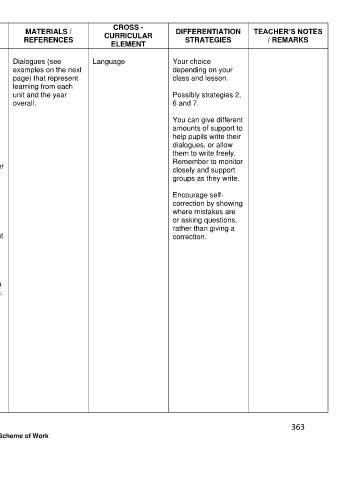
 MAIN SKILL   MAIN SKILL   Pre-lesson   Dialogues (see   Language    Your choice
       Review four key words, one from each unit. You   examples on the next   depending on your
 Language Arts    Language Arts   could use Task 1, 4 or 6.   page) that represent   class and lesson.
 5.3   5.3.1      learning from each
 Express an   Respond   Lesson delivery   unit and the year   Possibly strategies 2,
 imaginative response   imaginatively and   1. On the board, do a matching activity: Textbook   overall.   6 and 7.
 to literary texts   intelligibly through   unit to theme:
    creating simple art   Unit 1: At School   You can give different
    and craft products    Unit 2: Let’s Play!   amounts of support to
       Unit 3: Pet Show                     help pupils write their
    Other imaginative   Unit 4: Lunchtime   dialogues, or allow
    responses as                            them to write freely.
    appropriate   2. Make four or eight groups. Ask each group to   Remember to monitor
       brainstorm vocabulary and language they remember   closely and support
 from a different unit each. Give them a time limit.
                                            groups as they write.
       3. Ask groups to check in their textbooks. If
 COMPLEMENTARY   COMPLEMENTARY   necessary they can add or change their answers.   Encourage self-
 SKILL   SKILL                              correction by showing
       4. Ask each group to present their answers to the   where mistakes are
 Speaking   Speaking   class.               or asking questions,
 2.3   2.3.1                                rather than giving a
 Communicate   Introduce self to an   5. Read the dialogues – you can ask more proficient   correction.
 appropriately to a   audience using fixed   pupils to take different parts or you could use
 small or large group   phrases   puppets or similar to take on different roles. Pupils
 should tell you which unit it relates to.

 6. Tell groups they will be making similar dialogues
 to perform in the next LA lesson. Give each group a
 new unit to look at and ask them to write a dialogue.

 7. Monitor and help where needed.

 8. Groups can practise their dialogues a little.

 9. Remind pupils they will need to introduce
 themselves to the audience. Check they have the
 language for this and practise as appropriate.

 10. Collect their written dialogues at the end of the
 class to review.

 Post lesson
 Word ladders


                                                                         363
 Primary Year 1 Scheme of Work

