


Page 75 - Supplement_Primary-1_Neat
P. 75
Week
              I Can
                              CLASSIFYING MATTER                                                        3/4


                                                   •  Dolly Anne L. Idlisan


                         e identify the things we see by giving them names. Classifying
                         those that we identify makes it easier for us to make observations.
              WAnd through our observation, we see their similarities and
              differences.

                 Scientists are fond of classifying or grouping things because it makes
              communicating and organizing information easy. Matter can be classified

              based on their appearance (physical properties) and based on their
              structure (chemical properties). One of the principal ways of classifying
              matter is based on its simple observable state: solid, liquid, or gas.

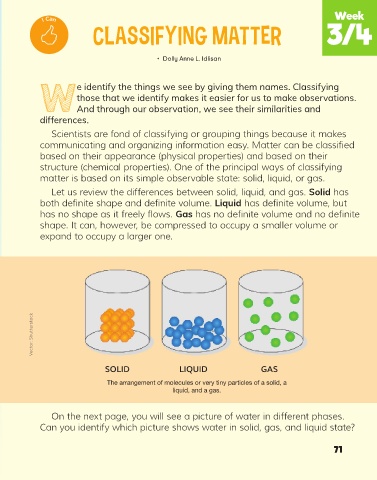
                 Let us review the differences between solid, liquid, and gas. Solid has
              both definite shape and definite volume. Liquid has definite volume, but
              has no shape as it freely flows. Gas has no definite volume and no definite
              shape. It can, however, be compressed to occupy a smaller volume or
              expand to occupy a larger one.


           Vector: Shutterstock


                                  SOLID                   LIQUID                   GAS


                                   The arrangement of molecules or very tiny particles of a solid, a
                                                       liquid, and a gas.


                 On the next page, you will see a picture of water in different phases.
              Can you identify which picture shows water in solid, gas, and liquid state?


                                                                                                          71

