


Page 39 - Lords of Madness: The Book of Aberrations
P. 39
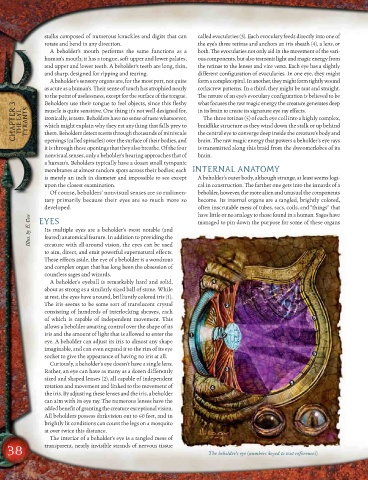
stalks composed of numerous knuckles and digits that can   called evocularies (3). Each evoculary feeds directly into one of
               rotate and bend in any direction.                 the eye’s three retinas and anchors an iris sheath (4), a lens, or
                 A  beholder’s  mouth  performs  the  same  functions  as  a   both. The evocularies not only aid in the movement of the vari-
               human’s mouth; it has a tongue, soft upper and lower palates,   ous components, but also transmit light and magic energy from
               and upper and lower teeth. A beholder’s teeth are long, thin,   the retinas to the lenses and vice versa. Each eye has a slightly
               and sharp, designed for ripping and tearing.      different configuration of evocularies. In one eye, they might

                 A beholder’s sensory organs are, for the most part, not quite   form a complex spiral. In another, they might form tightly wound
               as acute as a human’s. Their sense of touch has atrophied nearly   corkscrew patterns. In a third, they might be taut and straight.
               to the point of uselessness, except for the surface of the tongue.   The nature of an eye’s evoculary configuration is believed to be

               Beholders use their tongue to feel objects, since this fleshy
                                                                 what focuses the raw magic energy the creature generates deep

      CHAPTER 3  THE EYE   TYRANTS  muscle is quite sensitive. One thing it’s not well designed for,   in its brain to create its signature eye ray effects.
                                                                   The three retinas (5) of each eye coil into a highly complex,
               ironically, is taste. Beholders have no sense of taste whatsoever,
                                                                 braidlike structure as they wind down the stalk or up behind
               which might explain why they eat anything that falls prey to
               them. Beholders detect scents through thousands of miniscule
                                                                 the central eye to converge deep inside the creature’s body and
               openings (called spiracles) over the surface of their bodies, and
                                                                 is transmitted along this braid from the dweomerlobes of its
               it is through these openings that they also breathe. Of the four   brain. The raw magic energy that powers a beholder’s eye rays
               nonvisual senses, only a beholder’s hearing approaches that of   brain.
               a human’s. Beholders typically have a dozen small tympanic
               membranes at almost random spots across their bodies; each  INTERNAL ANATOMY
               is merely an inch in diameter and impossible to see except   A beholder’s outer body, although strange, at least seems logi-
               upon the closest examination.                     cal in construction. The farther one gets into the innards of a
                 Of course, beholders’ nonvisual senses are so rudimen-  beholder, however, the more alien and unusual the components
               tary  primarily  because  their  eyes  are  so  much  more  so   become. Its internal organs are a tangled, brightly colored,
               developed.                                        often inscrutable mess of tubes, sacs, coils, and “things” that
                                                                 have little or no analogy to those found in a human. Sages have
           Illus. by E. Cox  Its  multiple  eyes  are  a  beholder’s  most  notable  (and
              EYES
                                                                 managed to pin down the purpose for some of these organs
               feared) anatomical feature. In addition to providing the
               creature with all-around vision, the eyes can be used
               to aim, direct, and emit powerful supernatural effects.
               These effects aside, the eye of a beholder is a wondrous
               and complex organ that has long been the obsession of
               countless sages and wizards.
                 A  beholder’s  eyeball  is  remarkably  hard  and  solid,
               about as strong as a similarly sized ball of stone. While
               at rest, the eyes have a round, brilliantly colored iris (1).
               The iris seems to be some sort of translucent crystal
               consisting of hundreds of interlocking sheaves, each
               of  which  is  capable  of  independent  movement.  This
               allows a beholder amazing control over the shape of its
               iris and the amount of light that is allowed to enter the
               eye. A beholder can adjust its iris to almost any shape
               imaginable, and can even expand it to the rim of its eye
               socket to give the appearance of having no iris at all.
                 Curiously, a beholder’s eye doesn’t have a single lens.
               Rather, an eye can have as many as a dozen differently
               sized and shaped lenses (2), all capable of independent
               rotation and movement and linked to the movement of
               the iris. By adjusting these lenses and the iris, a beholder
               can aim with its eye ray. The numerous lenses have the

               added benefit of granting the creature exceptional vision.
               All beholders possess darkvision out to 60 feet, and in
               brightly lit conditions can count the legs on a mosquito
               at over twice this distance.
                 The interior of a beholder’s eye is a tangled mess of
               transparent, nearly invisible strands of nervous tissue
   38                                                               The beholder’s eye (numbers keyed to text references)

