


Page 40 - Lords of Madness: The Book of Aberrations
P. 40
TYRANTS  THE EYE   CHAPTER 3


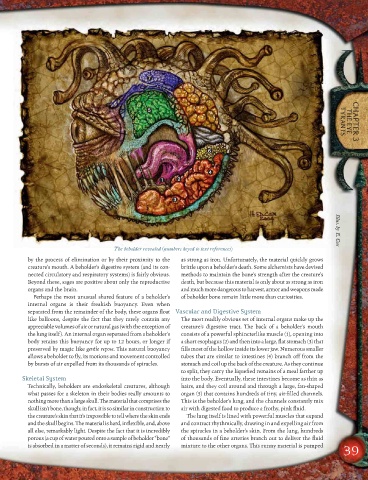
                                      The beholder revealed (numbers keyed to text references)                Illus. by E. Cox
          by the process of elimination or by their proximity to the   as strong as iron. Unfortunately, the material quickly grows
          creature’s mouth. A beholder’s digestive system (and its con-  brittle upon a beholder’s death. Some alchemists have devised
          nected circulatory and respiratory systems) is fairly obvious.   methods to maintain the bone’s strength after the creature’s
          Beyond these, sages are positive about only the reproductive   death, but because this material is only about as strong as iron
          organs and the brain.                             and much more dangerous to harvest, armor and weapons made
            Perhaps the most unusual shared feature of a beholder’s   of beholder bone remain little more than curiosities.
          internal  organs  is  their  freakish  buoyancy.  Even  when
          separated from the remainder of the body, these organs float  Vascular and Digestive System

          like balloons, despite the fact that they rarely contain any   The most readily obvious set of internal organs make up the
          appreciable volumes of air or natural gas (with the exception of   creature’s  digestive  tract.  The  back  of  a  beholder’s  mouth
          the lung itself). An internal organ separated from a beholder’s   consists of a powerful sphincterlike muscle (1), opening into
          body retains this buoyancy for up to 12 hours, or longer if   a short esophagus (2) and then into a large, flat stomach (3) that


          preserved by magic like gentle repose. This natural buoyancy   fills most of the hollow inside its lower jaw. Numerous smaller

          allows a beholder to fly, its motions and movement controlled   tubes that are similar to intestines (4) branch off from the
          by bursts of air expelled from its thousands of spiracles.  stomach and coil up the back of the creature. As they continue

                                                            to split, they carry the liquefied remains of a meal farther up
        Skeletal System                                     into the body. Eventually, these intestines become as thin as
          Technically,  beholders  are  endoskeletal  creatures,  although   hairs, and they coil around and through a large, fan-shaped
          what passes for a skeleton in their bodies really amounts to   organ (5) that contains hundreds of tiny, air-filled channels.

          nothing more than a large skull. The material that comprises the   This is the beholder’s lung, and the channels constantly mix
          skull isn’t bone, though; in fact, it is so similar in construction to   air with digested food to produce a frothy, pink fluid.

          the creature’s skin that it’s impossible to tell where the skin ends     The lung itself is lined with powerful muscles that expand
          and the skull begins. The material is hard, inflexible, and, above   and contract rhythmically, drawing in and expelling air from

          all else, remarkably light. Despite the fact that it is incredibly   the spiracles in a beholder’s skin. From the lung, hundreds


          porous (a cup of water poured onto a sample of beholder “bone”   of thousands of fine arteries branch out to deliver the fluid
          is absorbed in a matter of seconds), it remains rigid and nearly   mixture to the other organs. This runny material is pumped
                                                                                                                39

