


Page 109 - DK Children's Encyclopedia
P. 109
Food chains                                                                       SEE ALSO

                                                                                               ▸ ▸ Animal groups
                                                                                                p.22

           A food chain is the passing along of energy from food.                              ▸ ▸ Conservation  p.72
           Only plants can make their own food. All animals are part                           ▸ ▸ Eating  pp.104—105
           of a food chain, either eating plants or other animals.                             ▸ ▸ Food  p.106

           All animals need energy to grow, survive, and reproduce.                            ▸ ▸ Habitats  p.126
                                                                                               ▸ ▸ Photosynthesis
                                                                                                p.191


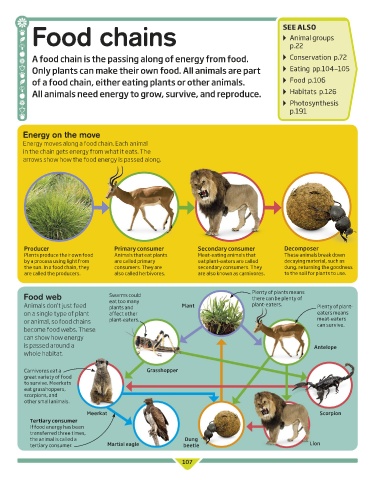
         Energy on the move
         Energy moves along a food chain. Each animal
         in the chain gets energy from what it eats. The
         arrows show how the food energy is passed along.


         Producer                     Primary consumer            Secondary consumer          Decomposer
         Plants produce their own food   Animals that eat plants   Meat-eating animals that    These animals break down
         by a process using light from   are called primary       eat plant-eaters are called   decaying material, such as
         the sun. In a food chain, they   consumers. They are     secondary consumers. They   dung, returning the goodness
         are called the producers.    also called herbivores.     are also known as carnivores.  to the soil for plants to use.


                                                                                   Plenty of plants means
         Food web                    Swarms could                                  there can be plenty of
                                     eat too many
         Animals don’t just feed     plants and             Plant                  plant-eaters.         Plenty of plant-
         on a single type of plant    affect other                                                       eaters means
         or animal, so food chains   plant-eaters.                                                       meat-eaters
                                                                                                         can survive.
         become food webs. These
         can show how energy
         is passed around a                                                                             Antelope
         whole habitat.


         Carnivores eat a                        Grasshopper
         great variety of food
         to survive. Meerkats
         eat grasshoppers,
         scorpions, and
         other small animals.
                             Meerkat                                                                     Scorpion
           Tertiary consumer
           If food energy has been
           transferred three times,
           the animal is called a                            Dung
           tertiary consumer.       Martial eagle            beetle                                   Lion

                                                             107


   US_107_Food_Chains.indd   107                                                                                 16/05/2017   09:47

