


Page 61 - Basic Course
P. 61
KNX BASIC COURSE

                  19  Line couplers replaced by KNXnet/IP routers


                                      Line coupler replaced by KNXnet/IP Router


                    Line 1.5       KNXnet/                                        KNXnet/          Line 2.5
                                   IP‐Router              Floor 5                 IP‐Router
                                    1.5.0                                          2.5.0


                                   KNXnet/                                        KNXnet/
                    Line 1.4                              Floor 4                                  Line 2.4
                                   IP‐Router                                      IP‐Router
                                    1.4.0                                          2.4.0

                                   KNXnet/                                        KNXnet/
                   Line 1.3        IP‐Router              Floor 3                 IP‐Router        Line 2.3
                                    1.3.0                                          2.3.0


                   Line 1.2        KNXnet/                                        KNXnet/          Line 2.2
                                   IP‐Router              Floor 2                 IP‐Router
                                    1.2.0                                          2.2.0


                                   KNXnet/                                        KNXnet/
                   Line 1.1                                                                        Line 2.1
                                   IP‐Router              Floor 1                 IP‐Router
                                    1.1.0                                          2.1.0
                            Area 1                                                    Area 2
                         (West wing)                      Network                  (East wing)
                                                           (LAN)
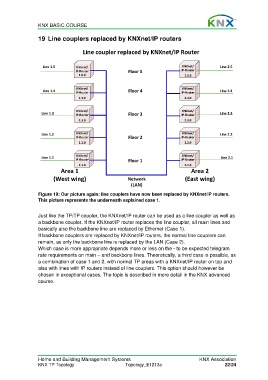
                  Figure 19: Our picture again: line couplers have now been replaced by KNXnet/IP routers.
                  This picture represents the underneath explained case 1.

                  Just like the TP/TP coupler, the KNXnet/IP router can be used as a line coupler as well as
                  a backbone coupler. If the KNXnet/IP router replaces the line coupler, all main lines and
                  basically also the backbone line are replaced by Ethernet (Case 1).
                  If backbone couplers are replaced by KNXnet/IP routers, the normal line couplers can
                  remain, as only the backbone line is replaced by the LAN (Case 2).
                  Which case is more appropriate depends more or less on the - to be expected telegram
                  rate requirements on main – and backbone lines. Theoretically, a third case is possible, as
                  a combination of case 1 and 2, with normal TP areas with a KNXnet/IP router on top and
                  also with lines with IP routers instead of line couplers. This option should however be
                  chosen in exceptional cases. The topic is described in more detail in the KNX advanced
                  course.


                  Home and Building Management Systems                                    KNX Association
                  KNX TP Topology                        Topology_E1213a                             22/24

